An International Journal
Agricultural and Biological Research
ISSN - 0970-1907
RNI # 24/103/2012-R1
RNI # 24/103/2012-R1
Research Article - (2025) Volume 41, Issue 6
Indian mustard (Brassica juncea (L). Czern and Cross) is the primary oilseed crop grown during the rabi season in India. It is vulnerable to frost, cold, and drought, it is sown early to avoid frost damage and harvested before the advent of frost. The crop is renowned for its high-quality oil and numerous by-products, contributing significantly to its value in both agricultural and industrial sectors. It is a major source of edible oil, contributing substantially to the country's oilseed production. Due to their rich nutritional content, these leaf and root crops are commonly cultivated as nutritious fodder for sheep and cattle. The oil content in Indian mustard seeds ranges from 38% to 46%, with the meal or oil cake making up nearly 50% of the entire seed. Following soybean, mustard constitutes approximately one-third of India's total oil production, solidifying its position as the nation's most significant edible oilseed crop. The cultivation of Indian mustard is challenged by factors such as pest and disease pressure. Over many diseases caused by fungi, bacteria, viruses, phytoplasma and nematodes have been identified as affecting the rapeseed-mustard group of oilseed crops in India. Among these biotic stresses, Alternaria leaf blight, caused by Alternaria brassicae (Berk.) Sacc., is particularly destructive, capable of causing significant yield losses in a short period. In this experiment, a total of six fungicides were tested for their effectiveness in managing Alternaria leaf blight disease. Result showed that all the fungicides were found significantly superior over control in controlling the disease. However, maximum disease control (73.82%) was recorded by trifloxystrobin 25%+tebuconazole 50% at 0.2% concentration. It was followed by Tebuconazole 25.9% EC (63.78%), Hexaconazole 5% EC (57.59%) and Propiconazole 25% EC (55.44%). Maximum pod yield was recorded by one spray of trifloxystrobin 25%+tebuconazole 50% WG 1523.33 kg ha-1 followed by tebuconazole 25.9% EC 1463.67 kg ha-1 and Hexaconazole 5% EC 1350.00 kg ha-1.
Alternaria leaf blight; Management; Fungicide; Mustard; Oilseed
Indian mustard (Brassica juncia (L). Czern and Cross) is the principle rabi oilseed crop in India. In most situations, a waxy layer covers the stems. The leaves are serrated, lobed, and have the larger terminal lobes on occasion. The yellow flowers grow clustered in groups of 5 to 12 blossoms [1]. Mustard is a cool season crop and is cultivated in the tropical as well as in the temperate climates. It is vulnerable to frost, cold, and drought, it is sown early to avoid frost damage and harvested before the advent of frost. It can be grown wide under rainfed as well as irrigated conditions. Brassica is high in dry matter digestibility @ 85 to 95% which contrasts with good alfalfa, @ 70%. Its leaves contain 18 to 25% crude protein, while the root contains about 10% crude protein. Due to their rich nutritional contents, these leaf and root crops have been commonly grown as nutritional fodder for sheep and cattle. The total seed-oil content in Indian mustard varies from 38-46% and meal or oil cake constitutes nearly 50% of the whole seed. The protein content ranges between 24-30% of the whole seed and 35-40% of the meal.
After soybean, mustard accounts for about one-third of India's oil production, making it the country's most important edible oilseed crop. India accounts for 19.29% of total mustard acreage and 11.27 percent of total mustard production globally [2]. India, Nepal, Canada, China, Pakistan, Bangladesh, and Sweden are the world's major mustard producers. In terms of production, Canada is the best in the world. It is mostly grown in Uttar Pradesh, Rajasthan, Madhya Pradesh, Bihar, and Gujarat in India. Rajasthan is India's biggest mustard producer, producing up to 49-50 percent of the country's total oil seed [3].
More than 22 disease caused by fungi, bacteria, virus, phytoplasma and nematode have been reported to affect rapeseed-mustard group of oilseed crops in India. Among the biotic ones, white rust caused by Albugo candida (Pers.) Kuntze and Alternaria leaf blight caused by Alternaria brassicae (Berk.)
Sacc. are the most destructive diseases of rapeseed mustard, which can cause high yield reduction within a short period of time. Alternaria blight can cause a yield loss of 10 to 71% and 32.57% [4]. A reduction of 24% in 1000 grain weight in mustard due to Alternaria blight was reported by Kolte, et al. Weather parameters also affect the disease development. Yield losses ranging between 23 to 54.5% due to white rust have been reported from India.
Alternaria blight is caused by the fungal pathogens Alternaria brassicae and Alternaria brassicicola, is a major disease of mustard (Brassica juncea), leading to significant yield losses (17-45%) and reduced oil quality. Conventional management relies heavily on synthetic fungicides, raising concerns about environmental damage, fungicide resistance, and human health Microorganisms like Trichoderma viride and Pseudomonas fluorescens produce metabolites that directly inhibit fungal growth. The specific symptoms typically associated with Alternaria leaf blight are leaf lesion, lesion expansion, leaf yellowing, lesion coalescence, stem and fruit infections, spore production, defoliation and reduced yield [5-7].
The present investigations were planned with the management of Alternaria blight disease through fungicides.
The experiment was conducted at RNB Global University, Bikaner. The seed of variety Krishna was sown in 21 plots with a plot size of 5 m2 each. The recommended agronomic practices like weeding, thinning, irrigation and fertilizer application were adopted. Eighteen plots were sprayed with different fungicides as per recommendation and three plots were kept unsprayed (Control). The first spray was applied after the disease initiation with different fungicides. The development of the diseases under the conditions of artificial inoculation of pathogen was studied. The data regarding disease intensity was calculated 20 days after the application of fungicides. The disease assessments were continued until there was a total defoliation in the untreated plots. The scoring scales (Tables 1 and 2) were used to assess the disease. The formula given by Wheeler (1969) was used to calculate the percent disease intensity (PDI) as follows:

| S. no. | Fungicides |
| T1 | Capton70%+hexaconazole 5% |
| T2 | Carbendazim 25%+iprodione 25% |
| T3 | Propiconazole 25% EC |
| T4 | Trifloxystrobin 25%+tebuconazole 50% WG |
| T5 | Tebuconazole 25.9% EC |
| T6 | Hexaconazole 5% EC |
| T7 | Control |
TABLE 1 Following fungicides were tested for its effect on Alternaria leaf blight of mustard
| Disease rating | Disease severity |
| 0 | No symptoms on leaf. |
| 1 | Small light brown spots scattered covering ≤ 5% leaf area. |
| 2 | Spots small, brown, with concentric rings, covering 5.1 to 10% leaf area. |
| 3 | Spots large, brown, irregular, with concentric rings, covering 10.1 to 25% leaf area. |
| 4 | Large, brown, irregular lesions with typical blight symptoms, covering 25.1 to 50% leaf area. |
| 5 | Large, brown, irregular lesions with typical blight symptoms, covering more than 50% leaf area. |
TABLE 2 Rating scale for scoring Alternaria blight
Six fungicides Capton70%+hexaconazole 5%, Carbendazim 25%+iprodione 25%, Propiconazole 25% EC, Trifloxystrobin 25% +tebuconazole 50% WG, Tebuconazole 25.9% EC and Hexaconazole 5% EC were tested as a foliar application to assessed for efficacy against Alternaria leaf blight of mustard under field condition. Data summerised in Table 1 showed that all the fungicides were found significantly superior over control in controlling the disease. However, maximum disease control (73.82%) was recorded by trifloxystrobin 25%+tebuconazole 50% at 0.2% concentration. It was followed by Tebuconazole 25.9% EC (63.78%), Hexaconazole 5% EC (57.59%) and Propiconazole 25% EC (55.44%). Trifloxystrobin 25%+tebuconazole 50% WG and tebuconazole 25.9% EC were found significantly superior as compared to rest of the fungicides. Minimum disease control (36.71%) was recorded by Capton 70% +hexaconazole 5% at 0.2% concentration [8-9].
All the fungicides were found significantly superior over control in increasing the pod yield. However, maximum pod yield was recorded by one spray of trifloxystrobin 25%+tebuconazole 50% WG 1523.33 kg ha-1 followed by tebuconazole 25.9% EC 1463.67 kg ha-1 and Hexaconazole 5% EC 1350.00 kg ha-1.
Similarly, Kumar and Rathi found that Foliar spray with mancozeb (0.2%) at 45 DAS followed by hexaconazole (0.05%) at 60 DAS was most effective in controlling Alternaria leaf blight severity up to 78.0 percent and Alternaria pod blight severity up to 56.5 percent and increased seed yield upto 29.9 percent as compared to untreated control. Rajvanshi, et al. worked on management of Alternaria blight of mustard caused by Alternaria brassicae (Berk) Sacc. and A. brassicicola (Schw) Wiltshire and found that T8-ST with thiram 2.5 g/kg seed+3 spray of Nativo at 0.05% was most effective with minimum mean disease severity 13.27%. Maximum yield (kg/ha) and increase in yield was also found in T8 1672.22 kg/ha and 70.05% respectively. Numerous scientists have conducted research over time to manage Alternaria blight disease in mustard using fungicides (Table 3 and Figure 1).
| Fungicides | Conc. (%) | Percent disease intensity | Yield (kg/ha) | Percent disease control |
| T1-Capton70%+hexaconazole 5% | 0.2 | 31.83 | 1126.67 | 36.71 |
| T2-Carbendazim 25%+iprodione 25% | 0.2 | 26.88 | 1243.33 | 46.57 |
| T3-Propiconazole 25% EC | 0.1 | 22.41 | 1320 | 55.44 |
| T4-Trifloxystrobin 25%+tebuconazole 50% WG | 0.2 | 13.17 | 1523.33 | 73.82 |
| T5-Tebuconazole 25.9% EC | 0.1 | 18.22 | 1463.67 | 63.78 |
| T6-Hexaconazole 5% EC | 0.1 | 21.33 | 1350 | 57.59 |
| T7-Control | 50.3 | 701.67 | 0 | |
| S.EM ± | 1.11 | 55.45 | ||
| CD (P=0.05) | 3.44 | 172.74 | ||
| CV (%) | 7.28 | 7.7 | ||
TABLE 3 Efficacy of different fungicides against Alternaria leaf blight of mustard
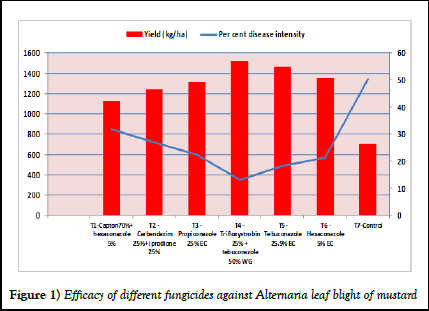
Figure 1) Efficacy of different fungicides against Alternaria leaf blight of mustard
Indian mustard (Brassica juncea (L). Czern and Cross) is the primary oilseed crop grown during the rabi season in India. Known for its robust adaptability to diverse agro-climatic conditions, Indian mustard thrives in cooler temperatures and is primarily grown in the northern and central regions of the country. Indian mustard plays a crucial role in India's agricultural economy. It is a major source of edible oil, contributing substantially to the country's oilseed production. The seeds yield a high amount of oil, which is widely used for cooking, food processing, and industrial applications. The crop also provides by-products such as mustard cake, which is used as livestock feed and as an organic fertilizer. The cultivation of Indian mustard is challenged by factors such as climate change, pest and disease pressure and unstable market prices. Over 22 diseases caused by fungi, bacteria, viruses, phytoplasma and nematodes have been identified as affecting the rapeseed-mustard group of oilseed crops in India. Among these biotic stresses, Alternaria leaf blight, caused by Alternaria brassicae (Berk.) Sacc., is particularly destructive, capable of causing significant yield losses in a short period. In this experiment, a total of six fungicides were tested for their effectiveness in managing Alternaria leaf blight disease. Result showed that all the fungicides were found significantly superior over control in controlling the disease. However, maximum disease control (73.82%) was recorded by trifloxystrobin 25%+tebuconazole 50% at 0.2% concentration. It was followed by Tebuconazole 25.9% EC (63.78%), Hexaconazole 5% EC (57.59%) and Propiconazole 25% EC (55.44%). Trifloxystrobin 25%+tebuconazole 50% WG and tebuconazole 25.9% EC were found significantly superior as compared to rest of the fungicides. Minimum disease control (36.71%) was recorded by Capton 70% +hexaconazole 5% at 0.2% concentration. Maximum pod yield was recorded by one spray of trifloxystrobin 25% + tebuconazole 50% WG 1523.33 kg ha-1 followed by tebuconazole 25.9% EC 1463.67 kg ha-1 and Hexaconazole 5% EC 1350.00 kg ha-1.
Received: 13-Jun-2024, Manuscript No. AGBIR-24-138905; , Pre QC No. AGBIR-24-138905 (PQ); Editor assigned: 17-Jun-2024, Pre QC No. AGBIR-24-138905 (PQ); Reviewed: 01-Jul-2024, QC No. AGBIR-24-138905; Revised: 11-Nov-2025, Manuscript No. AGBIR-24-138905 (R); Published: 18-Nov-2025, DOI: 10.37532/0970-1907.25.41(6):1-3