
An International Journal
Agricultural and Biological Research
ISSN - 0970-1907
RNI # 24/103/2012-R1
RNI # 24/103/2012-R1
Research Article - (2026) Volume 42, Issue 1
It is the objective of this research to determine the predation efficiency of Eucanthecona furcellata on Fall Armyworm. It was arranged in a Complete Randomized Design (CRD) with three treatments replicated seven times with ten FAW at different instars in separate containers. A two-way ANOVA was used to determine the differences between predator sexes and the instar preference of prey consumed by Eucanthecona furcellata. Means were separated by Tukey’s honestly significant differences test us probability level of 0.05. The laboratory conditions were 24-29 degrees Celsius with relative humidity of 55-85%. The predation efficiency of the male Eucanthecona furcellata decreased as the FAW larvae grew bigger from the third to sixth instar. Similarly, the predation efficiency of the female Eucanthecona furcellata decreased as the FAW larvae increased its sizes as they emerged from third to sixth instar. The combined male and female Eucanthecona furcellata yielded the most number of eaten FAW. There is a significant difference in the predation efficiency between the male Eucanthecona furcellata and the combined male and female Eucanthecona furcellata. Likewise, a significant difference in the predation efficiency existed between the female Eucanthecona furcellata and the combined male and female Eucanthecona furcellata.
Predation; Efficiency; Eucanthecona; Furcellata; Fall armyworm
Anthropogenic-mediated activities like globalization and climate change encourage the spread of insect pests outside of their natural habitat. Change [1], stated that a number of these species have the potential to spread and have detrimental consequences on livelihoods and agriculture, either directly or indirectly. Additionally, they endanger the productivity of agriculture and the ability of the introduced environment's ecosystem to function [2].
The frequency of agricultural pests in the Philippines has an impact on crop output, which in turn affects food security. The number and quality of crops can be diminished by pests including insects, illnesses, and weeds, which can result in food shortages and a decline in the availability of some crops.
A versatile crop with a large global production, corn is grown on 197 million hectares of land; 32% of the world's production comes from low and lowmiddle- income countries. Nearly 14 million Filipinos selected white corn as their primary food source, whereas nearly 50% of mixed feed for livestock was made from yellow corn, according to the Department of Agriculture.
FAW was discovered attacking cornfields in Piat, Cagayan, Philippines. Approximately 11,000 hectares (ha) of maize crops around the nation have been affected by the infestation. Currently, 208 municipalities, 47 provinces, and 8,000 hectares have been checked for FAW infestation. FAW larvae that are between 14 and 30 days old consume plant portions, which significantly reduces yield. The estimated financial loss as a result of the FAW infestation has surpassed P300 million.
Due to developed insect resistance, chemical management has been employed to manage insect pests for a long time but has not shown to be very successful. Augmentative biocontrol, releasing predators to combat the growing pest population of FAW, is the most effective method of managing FAW [3]. For many insect predators, the amount of time spent feeding in a no-choice environment can be used to gauge how successful their hunting techniques are. To have the ability to become a viable biological control agent for insect pests, a predator must possess effective predatory feeding behaviors. Measures of predatory efficiency can also include predator capacity, prey acceptance, or the daily prey fatality rate for each individual predator during the predator's developmental stage.
In the context of plant and environmental protection and sustainable agriculture, biological control consists of the use of biological control agents against insect pests was the subject of this study. The aim is to unravel the predation efficiency of the Eucanthecona furcellata in addressing FAW infestations, the major pest in maize cultivation.
Objectives of the study
It is the objective of this research to determine the predation efficiency of Eucanthecona furcellata on Fall Armyworm. Specifically:
• To determine the predation efficiency of male Eucanthecona furcellata Euca on Fall Armyworm.
• To determine the predation efficiency of female Eucanthecona furcellata on Fall Armyworm.
• To determine the predation efficiency of a combined male and female Eucanthecona furcellata on Fall Armyworm at third, fourth, fifth and sixth instar.
Research design
The study was arranged in a Complete Randomized Design (CRD) with four treatments replicated seven times at different instars in separate containers. A Two-way ANOVA was used to determine the differences between predator sexes and the instar preference of prey consumed by Eucanthecona furcellata. Means were separated by Tukey’s honestly significant differences test.
The first setup was 1 male Eucanthecona furcellata versus 10 prey with instar variations. Treatment 1 (third instar FAW), treatment 2 (fourth instar FAW), treatment 3 (fifth instar FAW) and treatment 4 (sixth instar FAW).
The second setup was 1 female Eucanthecona furcellata versus 10 prey with instar variations. Treatment 1 (third instar FAW), treatment 2 (fourth instar FAW), treatment 3 (fifth instar FAW) and treatment 4 (sixth instar FAW).
The third setup was 1 male and female Eucanthecona furcellata versus 20 prey with instar variations. Treatment 1 (third instar FAW), treatment 2 (fourth instar FAW), treatment 3 (fifth instar FAW) and treatment 4 (sixth instar FAW).
Locale of the study
The laboratory conditions were 24-29 degrees Celsius with relative humidity of 55-85%. The Eucanthecona furcellata were initially starved for 24 hours. Water supplied ad libitum. Young corn leaves were cut into 3 cm long and were also put into the container for FAW consumption.
Research experiment was conducted in a laboratory room in RCPC-IX, Sudlon, Molave, Zamboanga del Sur. The study on predation efficiency was conducted for eight days from February 19-27, 2024.
The mass rearing of FAW occurred on December 2023 to January 2024. The researcher collected 5th instar larvae of FAW. These larvae were allowed to pupate. The pupa was placed in the host plant like maize in the rearing gage. The adult FAW will undergo mating and oviposition. Eggs were collected and transferred to another rearing boxes for hatching. The first instar FAW were allowed to develop until it reached the third instar by then these were utilized for replication. Third, fourth, fifth and sixth instar FAW were collected for use in the investigation for predation efficiency of assassin bug.
Sampling method
Twenty-eight male Eucanthecona furcellata were taken from at random from a collection of male Eucanthecona furcellata which served as the First Treament (T1). Twenty-eight randomly selected female Eucanthecona furcellata were chosen from a collection of female Eucanthecona furcellata which served as predators of Second Treatment (T2). A combination of 28 males and 28 females were used for the Third Treatment (T3).
Sources of Eucanthecona furcellata and Fall Armyworm (FAW)
The Eucanthecona furcellata were sourced out from the Regional Crop Protection Center where they mass produced.
The Fall Armyworm (FAW) were sourced out from the corn fields situated in some barangays in the municipalities of Molave, Mahayag, and Dumingag, Zamboanga del Sur.
The mass rearing of FAW occurred on December 2023 to January 2024. The researcher collected 5th instar larvae of FAW. These larvae were allowed to pupate. The pupa was placed in the host plant like maize in the rearing gage. The adult FAW will undergo mating and oviposition. Eggs were collected and transferred to another rearing boxes for hatching. The first instar FAW were allowed to develop until it reached the third instar by then these were utilized for replication. Third, fourth, fifth and sixth instar FAW were collected for use in the investigation for predation efficiency of assassin bug.
The following materials were used in the study: Third to sixth instars FAW larvae, young corn for FAW diet, plastic containers, rearing cages, flowering pot, insect net, corn seeds, cotton balls, water sprayer 250 ml and Sterile Distilled Water (SDW).
Host plant
Zae maize was utilized as the host plant of FAW in the life table and predation study. A mixture of sandy loam, loam, organic cultivating soil, and peat soil were used to plant the corn (Tinigib) in 5-inch plastic pots, which measure 14.7 cm in diameter and 12.6 cm in height. The prescribed fertilizer application was made during the trial periods to support the growth and development of maize. Young leaves of corn were collected as the food source of FAW.
Insect rearing of Fall Armyworm (FAW)
In certain barangays within the municipality of Molave, Zamboanga del Sur, the adult FAW population and sixth instar larvae were collected from corn fields. The adult FAW was directly put in a rearing cage and allowed to lay eggs. The rearing cages measured 50 cm in diameter and 100 cm in height and were made of aluminum bars with mesh cloth for proper ventilation. Cotton balls soaked in 20% honey water were given to each container as adult food. Potted corn plants aging 15-20 DAP are used for oviposition of adult FAW. Every day, masses of eggs were gathered and preserved for hatching. The hatching containers measure 32 cm in diameter and 12 cm in height. The nymphal instar utilized in the study determines the classification of the recently hatched nymph.
The collected sixth instar FAW larvae were put in separate isolation tubes individually provided with young corn leaves. Each larva was monitored every day. When the FAW larvae develop into a pupa, it is then transferred to the rearing cage and placed on top of the soil of the potted corn plants inside the rearing cage. From then, waiting to pupate into adult FAW for mating, reproduction, and oviposition.
Rearing of Eucanthecona furcellata
The original colony of predatory bugs was provided by the Regional Crop Protection Center-IX, Molave, Zamboanga del Sur. Adult bugs were fed with larvae of FAW in a plastic container (13.5 cm in diameter, 18.5 cm in height). For ventilation, a fine mesh net will be placed over the tops of the containers. The male and female Eucanthecona furcellata are identified and separately set aside to be used for the predation test of FAW.
Predation efficiency study of Eucanthecona furcellata
The study was conducted in a laboratory room in RCPC-IX, Sudlon, Molave, Zamboanga del Sur. The predators were placed in a clear plastic container, 15 cm in diameter and 10 cm in height, with tops covered with mesh cloth. Each container will be provided with ten FAW larvae with a variation of instars and one Eucanthecona furcellata with a variation of sexes. The study on predation efficiency was conducted for eight days from February 19-27, 2024.
The first setup was 1 male Eucanthecona furcellata versus 10 prey with instar variations. Treatment 1 (third instar FAW), treatment 2 (fourth instar FAW), treatment 3 (fifth instar FAW) and treatment 4 (sixth instar FAW).
The second setup was 1 Female Eucanthecona furcellata versus 10 prey with instar variations. Treatment 1 (third instar FAW), treatment 2 (fourth instar FAW), treatment 3 (fifth instar FAW) and treatment 4 (sixth instar FAW).
The third setup was 1 male and female Eucanthecona furcellata versus 20 prey with instar variations. Treatment 1 (third instar FAW), treatment 2 (fourth instar FAW), treatment 3 (fifth instar FAW) and treatment 4 (sixth instar FAW).
Data gathering procedure
Predation analysis of predatory bug on FAW larval instar: The daily predation rate data of the predatory bug was analyzed based on the quantity of the number of dead and moribund larvae consumed by Eucanthecona furcellata within 24 hours. Daily records for eight days were done (Figures 1-7).
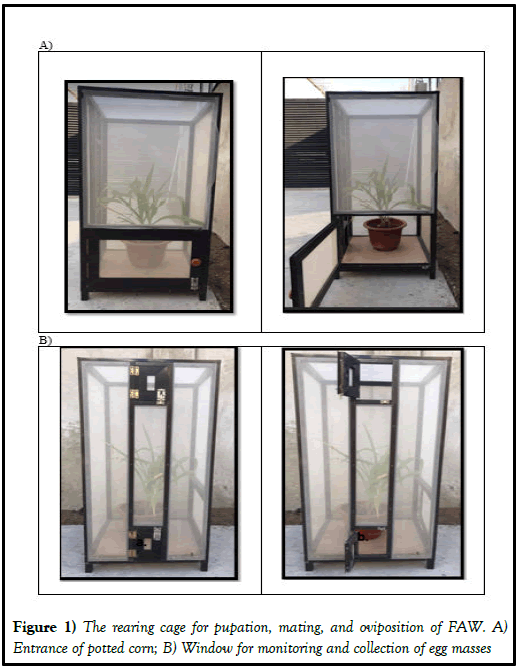
Figure 1) The rearing cage for pupation, mating, and oviposition of FAW. A) Entrance of potted corn; B) Window for monitoring and collection of egg masses
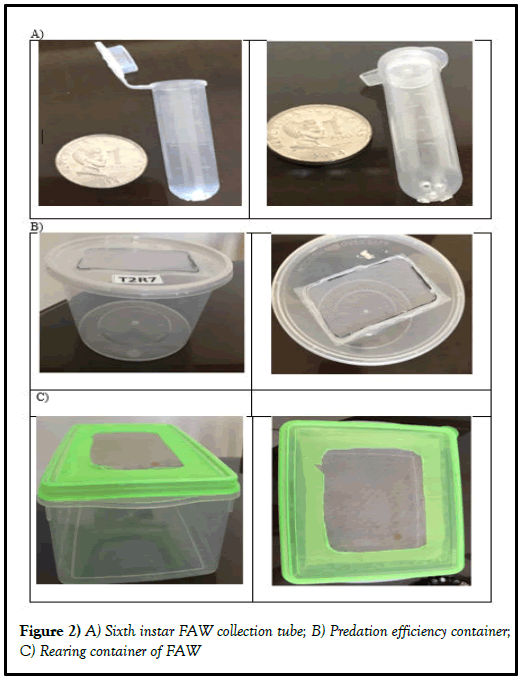
Figure 2) A) Sixth instar FAW collection tube; B) Predation efficiency container; C) Rearing container of FAW
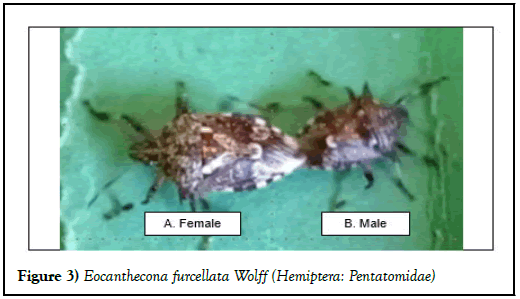
Figure 3) Eocanthecona furcellata Wolff (Hemiptera: Pentatomidae)
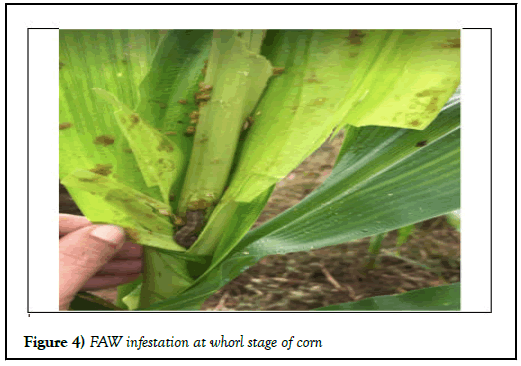
Figure 4) FAW infestation at whorl stage of corn
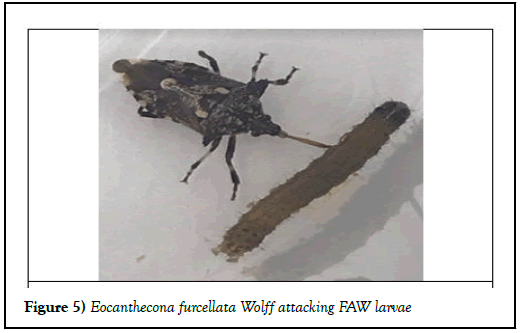
Figure 5) Eocanthecona furcellata Wolff attacking FAW larvae
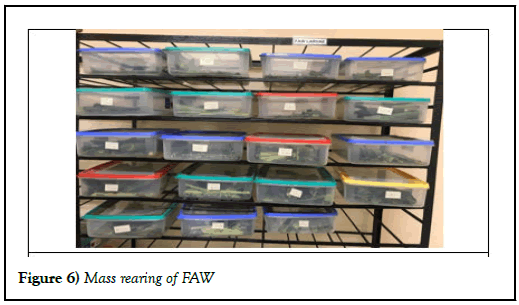
Figure 6) Mass rearing of FAW
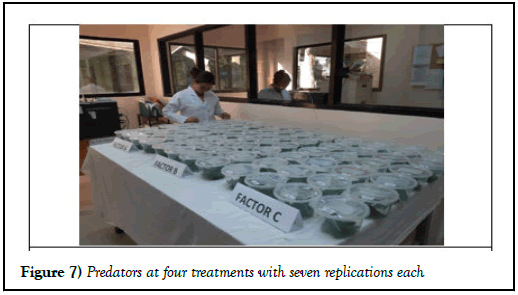
Figure 7) Predators at four treatments with seven replications each
Predation efficiency of male Eucanthecona furcellata
Table 1 shows the predation efficiency of male Eucanthecona furcellata. Each predation container contains one male assassin bug. There were four treatments in each factor with seven replications each treatment. The first treatment (T1) contains 10 third instar FAW; the second treatment with 10 fourth instar FAW; third treatment with 10 fifth instar FAW; and fourth treatment with 10 sixth instar FAW.
As revealed in the table, day 1 has the highest percent of predation of FAW during which these are on the third instar. The predation efficiency of the Eucanthecona furcellata on T1 decreased from day 1 to day 3 and established a uniform predation from day 4 to day 6.
Days 1 to 3 on T2, the Eucanthecona furcellata maintained a consumption of 2 FAW, and the remaining day 4 to 6 with one FAW per day. While in T3, an average of 2 FAW were consumed during the day 1 which diminished to an average of 1.57 FAW during day 2 and the rest of the four days (day 4 to day 6) with an average of one FAW per day. The same observations prevailed during the first three days in T4, however, none of the FAW were consumed during day 4 to day 6 by the Eucanthecona furcellata.
Further analysis of the data indicated that as the larvae proceeds from third instar to the next stages, fourth to sixth instar, the predation efficiency of the assassin bug decreased.
As their prey, like FAW matures from the third to the sixth instar, Eucanthecona furcellata's ability to prey may decrease for a number of reasons.
The larvae of FAW get larger as they mature into higher instars. Larger prey may be more difficult for Eucanthecona furcellata to capture and subdue than smaller ones [4]. The mature FAW larvae are larger than other types of larvae, which could make it more difficult for Eucanthecona furcellata to successfully feed on them. To fend off predators, armyworm larvae may evolve increasingly potent defence mechanisms as they get older [5]. For instance, older larvae may develop chemical defences or thicker cuticles that protect them from assassin bug predators. Compared to younger larvae, older armyworm larvae are usually nimbler and mobile [6]. Because of their greater agility, Eucanthecona furcellata may find it more difficult to capture and consume (Figure 8).
| Treatments | Day 1 | Day 2 | Day 3 | Day 4 | Day 5 | Day 6 |
| T1 – 3rd Instar | 2.57 | 2.14 | 1.86 | 1 | 1 | 1 |
| T2 – 4th Instar | 2 | 2 | 2 | 1 | 1 | 1 |
| T3 – 5th Instar | 2 | 1.57 | 1 | 1 | 1 | 1 |
| T4 – 6th Instar | 2 | 1.57 | 1 | 0 | 0 | 0 |
TABLE 1 Predation efficiency of male Eucanthecona furcellata
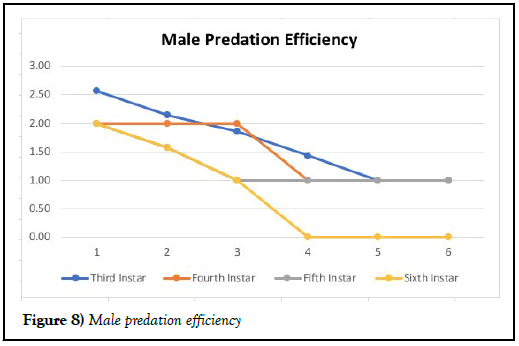
Figure 8) Male predation efficiency
Predation efficiency of female assassin bug
The predation efficiency of female Eucanthecona furcellata are reflected in Table 2. It can be observed from the data that as the fall armyworm leveled up from third to sixth instar, the predation efficiency of the Eucanthecona furcellata decreased from day 1 to day 6. Comparing the previous Table 1 with the male Eucanthecona furcellata as a factor, the observation on diminishing predation efficiency was also prevalent in Table 2. However, it is also noted that comparing the predation efficiencies, the female Eucanthecona furcellata have greater FAW consumption when considering the same treatments (Figure 9).
| Treatments | Day 1 | Day 2 | Day 3 | Day 4 | Day 5 | Day 6 |
| T1 – 3rd Instar | 3.57 | 2.14 | 1 | 1.43 | 1 | 1 |
| T2 – 4th Instar | 2.57 | 2 | 2 | 1 | 1 | 1 |
| T3 – 5th Instar | 3 | 2 | 1.43 | 1 | 1 | 1 |
| T4 – 6th Instar | 2 | 1 | 1 | 0 | 0 | 0 |
TABLE 2 Predation efficiency of female Eucanthecona furcellata
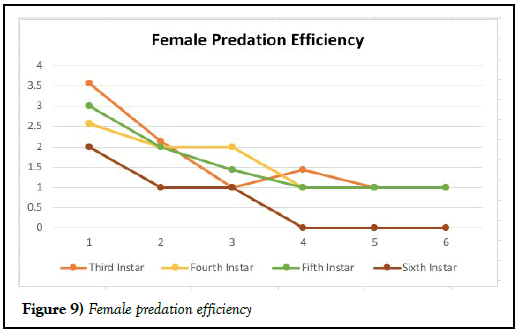
Figure 9) Female predation efficiency
Predation efficiency of the combined male and female Eucanthecona furcellata
At this point, it should be noted that a total of 56 Eucanthecona furcellata, 28 males and 28 females were utilized as factors with the same number of treatments (third instar to sixth instar). A total of 560 FAW were utilized during the entire predation processes.
Generally, the predation efficiency of the combined male and female Eucanthecona furcellata declined from day 1 to day 6 especially when the FAW were on their third, fourth and fifth instar (T1, T2, and T3), with a slight irregularity in T4 using sixth instar larvae when an average of 4.43 FAW were consumed during day 1, then 1.86 on day 2 and slightly increased to an average of 2 FAW during day 3.
The aggression of Eucanthecona furcellata towards FAW may account for the increased mortality rate seen during the first three days. According to Hema [7], eating of prey rises as prey populations rise. According to Sahayaraj and Paulraj [8], when fed FAW, Eucanthecona furcellata's nutritional needs increase after the first three days (Table 3 and Figure 10).
| Treatments | Day 1 | Day 2 | Day 3 | Day 4 | Day 5 | Day 6 |
| T1 – 3rd Instar | 6.86 | 4.43 | 2.86 | 2.43 | 1.86 | 1.57 |
| T2 – 4th Instar | 6 | 5 | 2.71 | 2.43 | 1 | 1 |
| T3 – 5th Instar | 5 | 4 | 2.43 | 1 | 1 | 1 |
| T4 – 6th Instar | 4.43 | 1.86 | 2 | 0 | 0 | 0 |
TABLE 3 Predation efficiency of male and female Eucanthecona furcellata
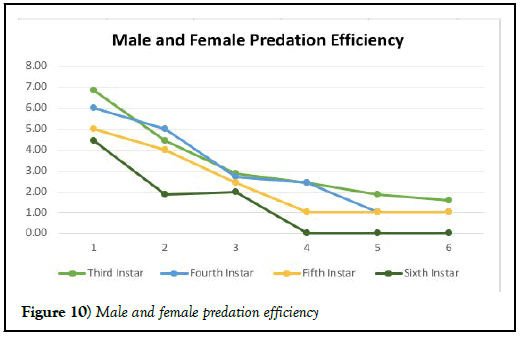
Figure 10) Male and female predation efficiency
Test for significant difference in the predation efficiency of the three factors
The Two-way analysis of variance with replication was utilized to analyze the data on the predation efficiency for the factors (male Eucanthecona furcellata, female Eucanthecona furcellata, and combined male and female Eucanthecona furcellata). Means were separated by Tukey’s test at p-0.05.
In Table 4, the data analyses used to establish the significance of the difference among the factors at corresponding treatments are shown. The results of the two-way analysis of variance with replication manifested that the differences of the means (1.238 and 1.155) exceed the Tukey’s value of 0.164 at the Q value of 3.61 with 18 degrees of freedom. This signify that the hypothesis is rejected, hence, significant.
| Factors | Means | Difference of Means | Tukey’s Value | Decision |
| Male | xM=1.298 | 0.083 | 0.164 | Not Significant |
| Female | xF=1.381 | |||
| Male | xM=1.298 | 1.238 | 0.164 | Significant |
| Male/Female | xM-F=2.536 | |||
| Female | xF=1.381 | 1.155 | 0.164 | Significant |
| Male/Female | xM-F=2.536 |
TABLE 4 Test for significant difference in the predation efficiency of the three factors
Hypothesis: There is no significant difference among the factors at different treatments.
There is a significant difference between the predation efficiency of male Eucanthecona furcellata and the combined male and female Eucanthecona furcellata. Likewise, there is a significant difference the predation efficiency of female Eucanthecona furcellata and the combined male and female Eucanthecona furcellata.
Further examining the comparison between the male assassin bug and the female assassin bug predation efficiencies, the data indicates that the mean difference of 0.083 is below the Tukey’s value of 0.164, hence not significant. Thus, there is no significant difference between the male Eucanthecona furcellata and the female Eucanthecona furcellata in terms of their predation efficiencies taking the different treatments (third to sixth instar larvae as preys).
The findings imply that the predation efficiency of the male Eucanthecona furcellata could different, in this case lesser than the predation efficiency of the combined male and female Eucanthecona furcellata. This could be attributed to the fact that when pursuing and capturing prey, female Eucanthecona furcellata frequently work in tandem with males. When compared to males hunting alone, their combined ability to locate, subdue, and consume prey increases their overall effectiveness of predation. In addition, compared to males, female Eucanthecona furcellata may be more adept at capturing and immobilizing prey. They might possess enhanced coordination, agility, or other skills that enable them to hunt more successfully. The particular abilities of female Eucanthecona furcellata, when paired with those of males, can increase the group's overall efficiency in predation. Furthermore, males and females of certain Eucanthecona furcellata species may play different roles in the hunting process. For instance, males might be skilled at subduing and eating prey, whereas females might be more adept at finding it. The overall predation efficiency of male and female Eucanthecona furcellata can be increased by cooperating and leveraging their individual talents.
The study of the predation efficiency of the Eucanthecona furcellata on Fall Armyworm (FAW) showed that this predators Eucanthecona furcellata killed significantly more FAW when their population was high. This predator caused higher level of mortality during the first three days across the four treatments with third, fourth, fifth and sixth instar larvae FAW.
Eucanthecona furcellata's ability to prey decreases as their prey matures from the third to sixth instar. Larger FAW larvae make it harder for them to capture and subdue. Older armyworm larvae develop stronger defense mechanisms, such as chemical defenses or thicker cuticles, making them nimbler and mobile, making it harder for them to capture and consume.
The Department of Agriculture, to ensure that corn protection programs and activities should be closely monitored to identify early signs of insect pest infestation. With these, they could forge and apply preventive measures to address the crop damages.
Farmers to keep themselves updated and informed on the DA’s programs for crop protection especially the use of biological control instead of chemical control as the least card for insect pest management.
Future researchers, to conduct investigations or experimentations using AB as the predator with other insect pest like cat worms, corn boarers, and other lepidopterous insects. Field trials may also be undertaken considering the predation efficiency of Eucanthecona furcellata on FAW in laboratories setups.