An International Journal
Agricultural and Biological Research
ISSN - 0970-1907
RNI # 24/103/2012-R1
RNI # 24/103/2012-R1
Research Article - (2026) Volume 42, Issue 2
Vegetative propagation of Excelsa coffee (Coffea excelsa A. Chev) is challenging due to its dense, narrow, compact, and three-layered sclerenchyma band, which inhibits root formation. Therefore, developing a micropropagation protocol for this species is required to address this limitation to support sustainable coffee production. This study aimed to induce callus formation in leaf explants of Excelsa coffee using 2,4-D and Benzyl Amino Purine (BAP), as an initial step toward developing an efficient and reproducible micropropagation protocol. A 2 × 4 factorial experiment was conducted in a Completely Randomized Design (CRD) with three replications. Immature and mature leaf explants served as Factor A, and the concentrations of 2,4 D and BAP as Factor B. Results revealed that both immature and mature leaf explants successfully formed callus, with immature explants initiating callus earlier 14 Days After Inoculation (DAI) than mature explants (17 DAI). Among the plant growth regulator treatments, the combination of 2.0 mg/L BAP+2.0 mg/L 2,4-D resulted in the earliest callus formation (19 DAI) and gave the highest percent callus formation (61.34%). Notably, plant growth regulators significantly influenced browning (%) and contamination (%) of the explants. These findings demonstrate that Excelsa coffee callus formation can be induced by plant growth regulators, and both mature and immature leaf explants can be used for callus induction. To our knowledge, this is one of the first reports on callus formation in Excelsa coffee, providing valuable information for future micropropagation studies of this important coffee species.
Excelsa coffee; Callus; Leaf explants; Benzylaminopurine; 2,4-Dichlorophenoxyacetic acid
Coffee is one of the world's most valuable agricultural commodities, with Arabica and Robusta accounting for most global production [1]. In the Philippines, coffee production has steadily declined because of constraints that include limited availability of high-quality planting materials [2]. Coffee production is also sensitive to climatic variability and rising temperatures [3, 4]. Consequently, there is growing interest in developing efficient propagation techniques for alternative coffee species, such as Excelsa (Coffea excelsa A. Chev.), which is recognized for its adaptability and resilience.
Unlike Arabica and Robusta, Excelsa is difficult to propagate by stem cuttings due to its compact sclerenchyma, which inhibits root initiation [5]. Tissue culture, therefore, offers a promising alternative for the rapid multiplication of elite planting materials.
Callus induction is a critical step in plant regeneration through tissue culture and is influenced by explant type and the balance between auxins and cytokinins [6, 7]. Plant growth regulators are central to agricultural and horticultural tissue-culture responses, while plant cell cultures provide controlled systems for regeneration and secondary-metabolite production [8-11]. Previous studies demonstrated that combinations of BAP and 2,4-D successfully induced callus in Liberica coffee; however, no information is available for Excelsa coffee. Therefore, this study evaluated the response of immature and mature leaf explants to different concentrations of BAP and 2,4-D to establish an efficient protocol for callus induction [12].
Experimental site and culture medium
The study was conducted at the Plant Tissue Culture Laboratory, Department of Horticulture, Visayas State University, Baybay City, Leyte, Philippines. Murashige and Skoog (MS) medium supplemented with vitamins, 30 g L-1 sucrose, and 5 g L-1 agar was used as the basal medium. The pH was adjusted to 5.8 ± 0.1 before autoclaving at 121°C and 15 psi for 20 min. Approximately 10 mL of medium was dispensed into each culture vessel.
Experimental design
The experiment was arranged in a 2 × 4 factorial experiment using a Completely Randomized Design (CRD) with three replications. Factor A consisted of two leaf explant types (immature and mature), while Factor B comprised four culture media: (1) MS alone (control), (2) MS+1.0 mg L-1 BAP+2.0 mg L-1 2,4-D, (3) MS+1.5 mg L-1 BAP+2.0 mg L-1 2,4-D, and (4) MS+2.0 mg L-1 BAP+2.0 mg L-1 2,4-D. Each treatment consisted of ten explants, resulting in 24 experimental units.
Explant collection and sterilization
Immature and mature leaves of Coffea excelsa were collected from the Coffee and Cacao Production Project of the Department of Horticulture, Visayas State University. Leaf maturity was determined following the criteria of where immature leaves were less than two months old, whereas mature leaves were fully expanded, green, and 2–5 months old [13].
The leaves were washed thoroughly with liquid soap under running tap water, rinsed, and surface-cleaned with 95% ethanol. They were then soaked in distilled water containing Tween-40 for 40 min, rinsed three times with sterile distilled water, immersed in 5% chloramphenicol for 20 min, and disinfected with 1% sodium hypochlorite (NaOCl) for 5 min. Finally, the explants were rinsed three times with sterile distilled water before inoculation.
Callus induction
Surface-sterilized leaves were cut into approximately 1 cm² sections containing the midrib and major veins. Individual explants were cultured in McCartney bottles containing the appropriate treatment medium. Cultures were incubated at 25 ± 2°C under cool-white fluorescent light (2,500 lux) with an 8-h photoperiod for four weeks.
Data collection
Data recorded after four weeks of culture included days to callus formation, percentage callus formation, browning, contamination, and survival.
Statistical analysis
Data were subjected to two-way analysis of variance (ANOVA) appropriate for a Completely Randomized Design (CRD). Treatment means were compared using the Honest Significant Difference (HSD) test at the 5% significance level. Statistical analyses were performed using the Statistical Tool for Agricultural Research (STAR) software developed by the International Rice Research Institute (IRRI).
Days to callus formation
The effects of leaf explant type and plant growth regulators (PGRs) on days to callus formation are presented in Table 1. Both factors significantly influenced callus initiation, and a significant interaction was observed between explant type and PGR treatment (Figure 1).
| Leaf explants (A) | Plant Growth Regulators (B) | Mean** | |||
|---|---|---|---|---|---|
| MS Alone | MS + 1.0 mg/l BAP + 2.0 mg/l 2,4-D | MS + 1.5 mg/l BAP + 2.0 mg/l 2,4-D | MS + 2.0 mg/l BAP + 2.0 mg/l 2,4-D | ||
| Immature leaf | 0.00 b | 20.00 a | 20.00 a | 16.00 a | 14.00 a |
| Mature leaf | 0.00 b | 22.00 a | 23.00 a | 23.00 a | 17.00 b |
| Mean | 0.00 c | 21.00 b | 22.00 a | 19.00 a | |
Note: Treatment means in a column and rows with the same letter are not significantly different from each other (HSD). p-value (a) = 0.0000**; p-value (b) = 0.0000**; p-value (axb) = 0.0003**; cv (%) = 6.1
Table 1: Days from incubation to callus formation of ‘Excelsa’Coffee using leaf explants and applied with different levels of Plant Growth Regulators
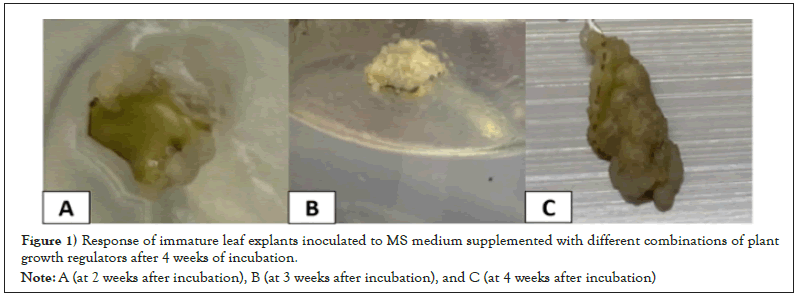
Figure 1: Response of immature leaf explants inoculated to MS medium supplemented with different combinations of plant growth regulators after 4 weeks of incubation. Note: A (at 2 weeks after incubation), B (at 3 weeks after incubation), and C (at 4 weeks after incubation)
Immature leaf explants produced callus significantly earlier (14 DAI) than mature leaves (17 DAI). Among the Plant Growth Regulator (PGR) treatments, MS supplemented with 2.0 mg L-1 BAP+2.0 mg L-1 2,4-D induced the earliest callus formation (19 DAI). The interaction analysis further showed that immature leaf explants cultured on the same medium formed callus earliest (16 DAI), indicating that younger tissues responded more rapidly to the applied growth regulators.
The present findings are consistent with those of Chaabani, et al. (2015) who reported enhanced callus induction with juvenile explants [14]. Likewise, Mayerni, et al. (2003) emphasized that explant age and the interaction between auxins and cytokinins strongly influence the onset of callus formation [15]. According to Swamy, et al. (2016), successful morphogenesis depends on a balance between endogenous hormones and exogenously supplied plant growth regulators, particularly auxins and cytokinins, which regulate cell division and organogenic responses [16].
Callus formation, browning, and contamination
Callus formation, browning, and survival responses after four weeks of culture are presented in Table 2. Leaf maturity did not significantly influence any of these parameters. In contrast, plant growth regulator (PGR) treatments significantly affected callus induction, browning, and contamination, while no significant interaction was observed between leaf explant type and PGR treatments Figure 2.
| Treatments | Callus formation (%) | Browning (%) | Survival (%) |
|---|---|---|---|
| Leaf explants (A) | |||
| Immature leaf | 50.04 | 49.95 | 71.66 |
| Mature leaf | 41.02 | 58.97 | 63.33 |
| Plant growth regulators (B) | |||
| MS Alone | 0.000 b | 100.00 b | 43.33 b |
| MS + 1.0 mg/l BAP + 2.0 mg/l 2,4-D | 60.89 a | 39.10 a | 71.66 a |
| MS + 1.5 mg/l BAP + 2.0 mg/l 2,4-D | 59.91 a | 40.08 a | 75.00 a |
| MS + 2.0 mg/l BAP + 2.0 mg/l 2,4-D | 61.34 a | 38.65 a | 80.00 a |
| p-value | |||
| (a) | 0.0832ns | 0.0831ns | 0.1885ns |
| (b) | 0.0000** | 0.0000** | 0.0025** |
| (a×b) | 0.2307ns | 0.2306ns | 0.2440ns |
| C.V. (%) | 26.25 | 21.95 | 22.02 |
Note: Treatment means are in a column with the same letter, and those without letters are not significantly different from each other (HSD)
Table 2: Callus formation (%) and browning (%) of ‘Excelsa’ coffee using leaf explants and applied with different levels of Plant Growth
Regulators after 4 weeks of incubation
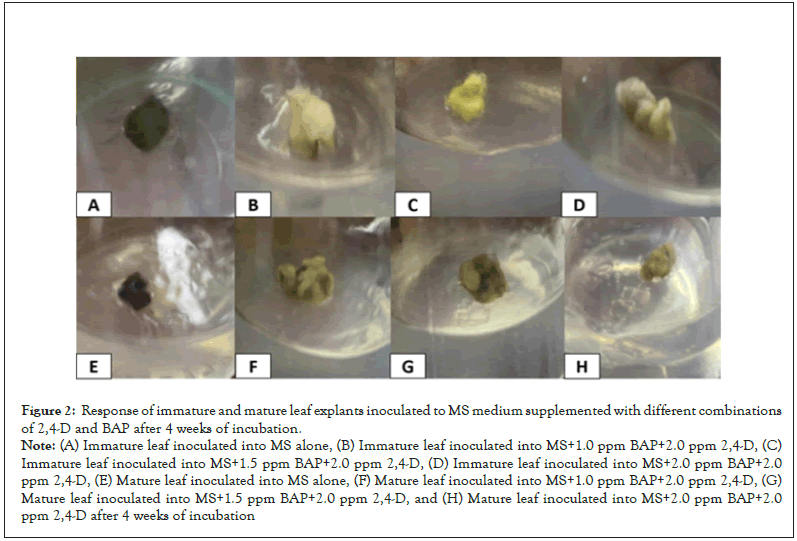
Figure 2: Response of immature and mature leaf explants inoculated to MS medium supplemented with different combinations of 2,4-D and BAP after 4 weeks of incubation.
Note: (A) Immature leaf inoculated into MS alone, (B) Immature leaf inoculated into MS+1.0 ppm BAP+2.0 ppm 2,4-D, (C) Immature leaf inoculated into MS+1.5 ppm BAP+2.0 ppm 2,4-D, (D) Immature leaf inoculated into MS+2.0 ppm BAP+2.0 ppm 2,4-D, (E) Mature leaf inoculated into MS alone, (F) Mature leaf inoculated into MS+1.0 ppm BAP+2.0 ppm 2,4-D, (G) Mature leaf inoculated into MS+1.5 ppm BAP+2.0 ppm 2,4-D, and (H) Mature leaf inoculated into MS+2.0 ppm BAP+2.0 ppm 2,4-D after 4 weeks of incubation
Media supplemented with 1.0, 1.5, and 2.0 mg L-1 BAP combined with 2.0 mg L-1 2,4-D significantly increased callus formation (59.91–61.34%) while markedly reducing tissue browning (38.65–40.08%) compared with the control, which produced no callus and exhibited complete browning. These results indicate that the combined application of auxin and cytokinin created a favorable hormonal balance for cell dedifferentiation and proliferation while minimizing tissue oxidation during culture establishment.
Similarly, percent survival was significantly influenced by PGR supplementation. Cultures grown on media containing 1.0–2.0 mg L-1 BAP with 2.0 mg L-1 2,4-D recorded significantly higher percent survival than untreated cultures, with the 2.0 mg L-1 BAP+2.0 mg L-1 2,4-D treatment showing the best response. The favorable survival observed in these treatments may be attributable to healthier, more actively proliferating tissues under optimized culture conditions, as well as to the effectiveness of the sterilization protocol.
The enhanced callus induction observed in PGR-supplemented media is consistent with the findings of Sherkar and Chavan (2014), who reported improved callus induction following the combined application of 2,4-D and BAP [17]. The synergistic interaction between auxins and cytokinins promotes cell division, cell differentiation, and protein synthesis, thereby stimulating callus proliferation [15]. Auxins regulate cell expansion, division, differentiation, root initiation, and tropic responses [18], whereas cytokinins stimulate mitosis, chloroplast development, and the expression of genes involved in cell growth [19].
The present study demonstrated that leaf explant maturity and plant growth regulator (PGR) supplementation significantly influenced the in vitro callus development of Coffea excelsa A. Chev. Immature leaf explants exhibited earlier callus initiation than mature leaves, indicating their greater responsiveness under in vitro conditions. Among the PGR treatments, MS medium supplemented with 2.0 mg L-¹ BAP+2.0 mg L-¹ 2,4-D was the most effective, promoting the earliest callus formation, the highest percentage of callus induction, reduced tissue browning and contamination, and the greatest explant survival. These findings suggest that the combination of immature leaf explants and 2.0 mg L-¹ BAP+2.0 mg L-¹ 2,4-D provides a suitable protocol for callus induction in C. excelsa. This study establishes a foundation for developing an efficient micropropagation system for this difficult-to-propagate coffee species. Future research should evaluate the embryogenic potential of the induced calli and optimize culture conditions for somatic embryogenesis and complete plant regeneration.
We would like to acknowledge the Department of Science and Technology and the J.H. Cerilles State College for funding this research. Appreciation is also extended to the VSU Administration for providing laboratory facilities.
The authors have declared that no competing interests exist.
[Google Scholar] [Crossref] [Pubmed]
[Google Scholar] [Pubmed]
[Google Scholar] [Crossref] [Pubmed]
[Google Scholar] [Crossref] [Pubmed]
[Google Scholar] [Crossref] [Pubmed]
[Google Scholar] [Crossref] [Pubmed]
Citation: Paler A. Plant growth regulators induce callus formation in excelsa coffee (coffea excelsa A.Chev.) leaf explants AGBIR.2026;42(2):1-4.
Received: 15-Jun-2026, Manuscript No. AGBIR-26-193175; , Pre QC No. AGBIR-26-193175; Editor assigned: 17-Jun-2026, Pre QC No. AGBIR-26-193175; Reviewed: 01-Jul-2026, QC No. AGBIR-26-193175; Revised: 08-Jul-2026, Manuscript No. AGBIR-26-193175; Published: 15-Jul-2026, DOI: 10.35248/0970-1907.26.42.1-4
Copyright: This open-access article is distributed under the terms of the Creative Commons Attribution Non-Commercial License (CC BY-NC) (http://creativecommons.org/licenses/by-nc/4.0/), which permits reuse, distribution and reproduction of the article, provided that the original work is properly cited and the reuse is restricted to noncommercial purposes. For commercial reuse, contact reprints@pulsus.com This is an open access article distributed under the terms of the Creative Commons Attribution License, which permits unrestricted use, distribution, and reproduction in any medium, provided the original work is properly cited.