An International Journal
Agricultural and Biological Research
ISSN - 0970-1907
RNI # 24/103/2012-R1
RNI # 24/103/2012-R1
Research Article - (2026) Volume 42, Issue 1
Environmental degradation, biodiversity loss, climate change, habitat fragmentation, and increasing anthropogenic pressures on natural ecosystems continue to threaten ecological stability and sustainable development worldwide. Addressing these challenges requires not only technological innovation and environmental policies but also the active participation of individuals in environmentally responsible behaviors. College students represent a critical population for environmental sustainability because they constitute future educators, researchers, policymakers, agricultural practitioners, and community leaders whose decisions will influence environmental outcomes. Understanding the factors that encourage environmental stewardship among young adults is therefore essential for advancing conservation and sustainability initiatives. This study investigates the influence of media literacy and information literacy on pro-environmental behavior among college students through tructural Equation Modeling (SEM). The research examines four dimensions of environmental behavior: Conservation lifestyle, land stewardship, social environmental engagement, and environmental citizenship. Media literacy refers to the ability to critically analyze, interpret, and evaluate environmental information disseminated through traditional and digital media platforms, whereas information literacy encompasses the skills required to identify, retrieve, evaluate, and utilize information effectively. The study is situated within the broader context of agricultural and biological research, emphasizing the role of environmental literacy in promoting ecological sustainability, biodiversity conservation, and responsible natural resource management. Drawing upon social cognitive theory, environmental literacy theory, and behavioral change models, the study proposes that literacy competencies significantly influence environmental attitudes and behavioral intentions.
Environmental literacy; Media literacy; Information literacy; Biodiversity conservation; Environmental stewardship; Ecology; Environmental science; Sustainability education; Structural equation modeling; Pro-environmental behavior
Global environmental challenges and the need for behavioral change
The twenty-first century is characterized by unprecedented environmental challenges that threaten the resilience and sustainability of natural ecosystems. Climate change, biodiversity loss, deforestation, land degradation, water scarcity, pollution, and habitat fragmentation have emerged as interconnected global concerns affecting both human societies and ecological systems. These environmental problems are increasingly recognized as products of complex interactions between biological processes, socioeconomic activities, technological development, and human behavior.
Recent scientific assessments indicate that biodiversity is declining at rates unmatched in human history. Thousands of species face extinction due to habitat destruction, invasive species, pollution, overexploitation, and climate-related disturbances. Simultaneously, agricultural systems are experiencing increased pressure from changing climatic conditions, declining soil quality, and reduced ecosystem services. Such environmental disruptions threaten food security, public health, economic development, and the long-term sustainability of biological resources.
Although scientific and technological advancements have contributed significantly to environmental monitoring and conservation efforts, technological solutions alone are insufficient to address contemporary environmental crises. Sustainable environmental management requires widespread behavioral changes among individuals, communities, institutions, and governments. Researchers increasingly acknowledge that environmental sustainability depends not only on scientific innovation but also on the willingness of individuals to adopt environmentally responsible practices.
Pro-environmental behavior represents one of the most important mechanisms through which individuals contribute to environmental protection and sustainability. Such behaviors include conserving water and energy, reducing waste generation, supporting biodiversity conservation, participating in environmental restoration activities, promoting sustainable consumption, and engaging in environmental advocacy. These actions collectively influence ecological outcomes at local, regional, and global scales.
Within agricultural and biological sciences, understanding the determinants of pro-environmental behavior is particularly important because environmental stewardship directly affects ecosystem health, biodiversity conservation, agricultural productivity, and natural resource sustainability. Consequently, identifying factors that encourage environmentally responsible behavior has become a major research priority across multiple disciplines, including ecology, environmental science, biology, conservation science, and sustainability studies.
Environmental stewardship in agricultural and biological systems
Environmental stewardship refers to the responsible use, management, and protection of natural resources to ensure ecological integrity and sustainability for present and future generations. Stewardship involves both individual and collective actions aimed at preserving ecosystem functions, maintaining biodiversity, and reducing environmental degradation.
Agricultural and biological systems are deeply interconnected with environmental stewardship. Agricultural activities depend on healthy ecosystems that provide essential services such as pollination, nutrient cycling, soil formation, water regulation, and climate stabilization. Similarly, biological diversity supports ecosystem resilience and enhances the capacity of natural systems to withstand environmental disturbances.
The concept of environmental stewardship extends beyond resource conservation to include active participation in habitat restoration, wildlife protection, sustainable land management, and environmental governance. Individuals who demonstrate strong stewardship behaviors often exhibit a heightened sense of environmental responsibility and ecological awareness.
Universities represent important institutions for cultivating environmental stewardship because they provide opportunities for students to acquire scientific knowledge, develop critical thinking skills, and engage in sustainability initiatives. Through formal education, experiential learning, and community engagement programs, higher education institutions can foster environmentally responsible behaviors that contribute to ecological sustainability.
Increasingly, environmental researchers recognize that educational interventions play a crucial role in shaping environmental attitudes and behaviors. Environmental education not only enhances ecological knowledge but also influences values, beliefs, and behavioral intentions related to environmental protection. Consequently, understanding the educational factors that promote environmental stewardship among college students remains an important area of investigation.
Media literacy and environmental awareness
The rapid expansion of digital communication technologies has transformed the way individuals access and interact with environmental information. News media, social networking platforms, scientific websites, documentaries, podcasts, and online educational resources provide unprecedented access to information concerning environmental issues.
However, the abundance of information available through digital platforms presents both opportunities and challenges. While individuals can easily access scientific information regarding climate change, biodiversity conservation, environmental health, and sustainable development, they are also exposed to misinformation, disinformation, and conflicting narratives.
Media literacy has emerged as a critical competency for navigating this complex information environment. Media literacy encompasses the ability to access, analyze, evaluate, interpret, and create media content across various platforms. Individuals with strong media literacy skills are better equipped to critically assess environmental messages, identify credible information sources, recognize biases, and distinguish scientific evidence from misinformation.
In environmental contexts, media literacy may influence how individuals perceive environmental risks, understand ecological processes, and respond to sustainability challenges. Exposure to scientifically accurate environmental information can increase awareness of environmental problems and motivate individuals to engage in conservation behaviors. Conversely, exposure to misleading or inaccurate information may undermine public understanding and reduce support for environmental initiatives.
Studies have suggested that media literacy contributes to environmental engagement by enhancing individuals' capacity to interpret environmental information critically. Through critical analysis of media content, individuals may develop stronger environmental attitudes, greater ecological awareness, and increased motivation to participate in environmental protection activities.
For college students, media literacy is particularly relevant because digital media constitute a primary source of environmental information. Students frequently encounter environmental content through social media platforms, online news sources, educational websites, and scientific publications. Their ability to evaluate and interpret this information may significantly influence their environmental knowledge and behavioral choices.
Information literacy and environmental decision-making
Information literacy represents another essential competency for addressing environmental challenges. Information literacy refers to the ability to recognize information needs, locate relevant information, evaluate information quality, and utilize information effectively to solve problems and make informed decisions.
Environmental issues are often characterized by complexity, uncertainty, and interdisciplinary interactions. Effective environmental decision-making therefore requires individuals to access reliable information from multiple sources and evaluate scientific evidence critically. Information literacy provides the foundation for these processes.
Individuals with strong information literacy skills are better able to understand environmental research findings, assess the credibility of information sources, interpret scientific data, and apply environmental knowledge to real-world situations. Such competencies are particularly important in contemporary society, where environmental information is increasingly disseminated through digital channels.
Within educational settings, information literacy contributes to academic success, lifelong learning, and informed citizenship. Students who possess strong information literacy skills are more likely to engage in evidence-based reasoning and develop informed perspectives on environmental issues.
From an environmental standpoint, information literacy may facilitate responsible behaviors by enabling individuals to understand the ecological consequences of their actions and evaluate alternative solutions to environmental problems. Information literacy may also enhance participation in environmental decision-making processes by increasing confidence in accessing and interpreting scientific information.
Nevertheless, researchers have suggested that information literacy alone may not guarantee behavioral change. Knowledge acquisition does not necessarily translate into action unless accompanied by motivational factors, social influences, and opportunities for engagement. Understanding the extent to which information literacy predicts environmental behavior therefore remains an important research question.
Environmental literacy as a framework for sustainable behavior
Environmental literacy provides a comprehensive framework for understanding the relationship between knowledge, attitudes, competencies, and environmental behavior. Environmental literacy encompasses cognitive, affective, and behavioral dimensions that collectively influence individuals' interactions with the environment.
The cognitive dimension involves environmental knowledge and understanding of ecological systems. The affective dimension includes environmental values, attitudes, concern, and emotional connections to nature. The behavioral dimension reflects actions undertaken to protect and sustain the environment.
Media literacy and information literacy may be considered critical components of environmental literacy because they enable individuals to access and interpret environmental information effectively. Together, these competencies support informed decision-making and responsible environmental behavior.
Researchers have proposed that environmentally literate individuals are more likely to participate in conservation activities, support environmental policies, engage in sustainable consumption, and advocate for environmental protection. Environmental literacy therefore serves as a bridge between environmental knowledge and environmental action.
Within agricultural and biological research, environmental literacy has gained increasing attention as a determinant of conservation behavior, ecosystem stewardship, and sustainable resource management.
Understanding how literacy competencies influence environmental behavior can inform the design of educational programs that promote ecological sustainability.
Research objectives
The study aims to investigate the predictive relationships between media literacy, information literacy, and environmental stewardship behaviors among college students.
Specifically, the study seeks to:
• Determine the level of environmental stewardship behavior among students.
• Assess the reliability and validity of media literacy, information literacy, and environmental behavior constructs.
• Examine the relationship between media literacy and environmental stewardship dimensions.
• Examine the relationship between information literacy and environmental stewardship dimensions.
• Develop a structural equation model predicting environmental stewardship behavior.
Research hypotheses
• H1: Media literacy significantly predicts conservation lifestyle behavior.
• H2: Media literacy significantly predicts land stewardship behavior.
• H3: Media literacy significantly predicts social environmental engagement.
• H4: Media literacy significantly predicts environmental citizenship.
• H5: Information literacy significantly predicts conservation lifestyle behavior.
• H6: Information literacy significantly predicts land stewardship behavior.
• H7: Information literacy significantly predicts social environmental engagement.
• H8: Information literacy significantly predicts environmental citizenship.
Research design
This study employed a predictive quantitative research design to investigate the influence of media literacy and information literacy on environmental stewardship behaviors among college students. Predictive research aims to identify and explain relationships among variables while developing models capable of estimating behavioral outcomes. The approach is particularly suitable for examining factors that contribute to environmental behavior because it allows researchers to evaluate direct and indirect relationships among latent constructs.
To examine the proposed relationships, Structural Equation Modeling (SEM) was utilized. SEM is widely recognized as a robust multivariate statistical technique capable of simultaneously assessing measurement reliability, construct validity, and structural relationships among variables. The method is extensively used in environmental science, behavioral research, ecology education, sustainability studies, and social science investigations due to its ability to model complex relationships among observed and latent variables.
The conceptual model proposed that media literacy and information literacy serve as predictor variables influencing four dimensions of environmental stewardship behavior:
• Conservation lifestyle
• Land stewardship
• Social environmental engagement
• Environmental citizenship
The structural model was developed to evaluate the extent to which literacy competencies contribute to environmentally responsible behavior among college students.
Study area and participants
The study was conducted among undergraduate students enrolled in teacher education programs at a state higher education institution during the academic year 2025–2026.
Students were selected because they represent an important demographic group whose environmental attitudes and behaviors can significantly influence future sustainability efforts. As future educators, community leaders, and professionals, their environmental competencies may affect environmental awareness and conservation practices within broader society.
A total of 220 students participated in the study. The sample exceeded the minimum requirement determined through statistical power analysis.
Sample adequacy was assessed using G*Power software. Following established recommendations for predictive modeling, a medium effect size (f2=0.15), significance level of 0.05, statistical power of 0.95, and two predictor variables were specified. The analysis indicated a minimum sample requirement of 107 participants.
The final sample of 220 participants therefore provided sufficient statistical power for structural equation modeling and increased the reliability of the findings.
Measurement model assessment
Indicator reliability: Indicator reliability was examined through outer loadings.
According to accepted SEM guidelines, indicators should demonstrate loadings greater than 0.708 to confirm adequate representation of their respective latent constructs.
The analysis revealed that all retained indicators exceeded the recommended threshold. Outer loadings ranged from 0.715 to 0.959, indicating strong relationships between indicators and their associated latent variables.
The results suggest that the measurement items effectively captured the underlying constructs of media literacy, information literacy, conservation lifestyle, land stewardship, social environmental engagement, and environmental citizenship.
Internal consistency reliability: Internal consistency reliability was evaluated using:
• Cronbach’s Alpha
• Composite Reliability (CR)
Composite reliability values above 0.70 indicate acceptable reliability, whereas values exceeding 0.90 reflect excellent internal consistency.
The findings demonstrated high reliability across all constructs.
Media literacy exhibited a composite reliability value of 0.945, while information literacy achieved a composite reliability value of 0.965.
Similarly, conservation lifestyle, land stewardship, social environmental engagement, and environmental citizenship all demonstrated composite reliability values exceeding recommended thresholds.
These results indicate that the measurement instrument possesses strong internal consistency and reliability.
Environmental stewardship behavior of students
The analysis revealed that students demonstrated satisfactory environmental stewardship behavior across all measured dimensions.
Conservation lifestyle
Students reported moderate to high engagement in environmentally responsible consumption practices.
Conservation lifestyle behaviors included:
• Recycling paper, plastic, and metal products.
• Conserving water resources.
• Conserving electrical energy.
• Purchasing environmentally friendly products.
The strongest response was associated with water and energy conservation practices.
These findings suggest that students recognize the importance of resource conservation in addressing environmental sustainability challenges.
From a biological perspective, reduced resource consumption contributes to ecosystem preservation by decreasing pressures on freshwater resources, energy production systems, and natural habitats.
Land stewardship
Students also demonstrated satisfactory levels of land stewardship behavior.
Participants reported involvement in activities supporting:
• Habitat conservation
• Ecological restoration
• Wildlife protection
• Biodiversity enhancement
Many students indicated efforts to improve surrounding environments for plants and animals through conservation-oriented practices.
Such activities are consistent with ecological stewardship principles emphasizing habitat quality and ecosystem resilience.
Land stewardship behaviors contribute to biodiversity conservation by promoting favorable conditions for native species and supporting ecosystem functions.
Social environmental engagement
Social environmental engagement received favorable evaluations.
Students actively participated in:
• Environmental discussions
• Sustainability initiatives
• Peer-based environmental activities
• Community conservation programs
The findings indicate that students recognize environmental sustainability as a collective responsibility requiring collaboration and community participation.
Social engagement facilitates knowledge exchange, environmental awareness, and collective action, all of which are critical for successful conservation outcomes.
Environmental citizenship
Environmental citizenship also demonstrated satisfactory levels.
Students expressed support for:
• Environmental regulations
• Conservation policies
• Environmental advocacy
• Community environmental initiatives
These findings suggest that participants are willing to engage in civic actions that contribute to environmental protection and sustainability.
Environmental citizenship is particularly important because policy support and public participation often determine the success of conservation programs and environmental management strategies.
Students’ level of pro-environmental behaviors
Table 1 shows the level of pro-environmental behavior of the students. As shown in the data, the conversation lifestyle of the students was generally satisfactory as revealed by the overall mean of 3.65. Most of the students clearly adhered to conserving water and energy especially as most of them are living in boarding houses. They have observed the scarcity of water within their community due to limited sources of potable or safe water presence in the areas. It is a significant behavior among students as they must have realized on the use of excess water and energy in terms of its impact on worldwide scarcity of water and energy supply. The students were careful not to have long showers or running faucets when bathing or using comfort rooms. The participants must have considered also the cost of over consuming water and energy not only to boarding house owners but its effects on the financial and environmental costs related to electricity demand. These realizations manifested the students’ pro-environmental behaviors. Lauer supported these by noting that with more efficient management of water and energy use, community can significantly affect operational costs and improve financial sustainability. Furthermore, he insisted that understanding the essence of water and energy savings implies understanding of the potential cost savings and environmental benefits of conservation efforts among student residences.
In terms of land ownership, the students registered an overall mean of 3.68 which is described as satisfactory. The students made their surroundings and areas more desirable and appropriate for plants and animals, with a mean of 3.75, interpreted as satisfactory. The students made transformations of their immediate surroundings by making these suitable habitats for plants and animals by undertaking different conservation and restoration activities. The students usually remove invasive species in their immediate surroundings, and encourage their parents to invest and plant native vegetation to support local biodiversity. The students manifested their pro-environmental behaviors arising from their sense of environmental identity and an understanding of the relationship between humans and the ecosystem.
The social environmentalism and environmental citizenship of the students were also satisfactory. This were based on the overall means of their perceptions (3.68 and 3.63). Most of the students participated in the local stewardship and initiative through either small financial contributions and material support in fostering protection of the local environment. The students interacted and collaborated with their classmates and peers in promoting environmental initiatives anchored on community contexts. According to Song et al., perceived social values are positively related to a student’s intention to engage in sustainable activities. They suggested that when students feel that their social group values the environment, they are also encouraged to do the same act accordingly. These efforts show that lifestyle of students and individuals changes to foster a culture of sustainability. Bauer et al., contended that when students participate in environmental groups through discussion with peers and classmates, they help establish informal social norms which could influence the interactions between humans and the environment.
| Statements | Mean | Standard deviation | Interpretation |
| Conservation lifestyle | |||
| Recycled paper, plastic and metal | 3.47 | 1.2 | Satisfactory |
| Conserved water or energy in my boarding house or home | 3.95 | 0.99 | Satisfactory |
| Buy environmentally friendly items or products | 3.52 | 1.06 | Satisfactory |
| Overall mean | 3.65 | 1.08 | Satisfactory |
| Land ownership | |||
| Made my land or surrounding more desirable for plants and animals | 3.75 | 1.06 | Satisfactory |
| Participate in initiative or study of environment conservation and ecology | 3.57 | 1.06 | Satisfactory |
| Volunteer to improve the environment and habitat of wildlife in my community | 3.73 | 1.05 | Satisfactory |
| Overall mean | 3.68 | 1.06 | Satisfactory |
| Social environmentalism | |||
| Talk to others in my community about environmental issues | 3.51 | 0.97 | Satisfactory |
| Work with others → friends or classmates → to address an environmental problem or issue | 3.76 | 1.01 | Satisfactory |
| Participate in a local environmental stewardship or initiate group | 3.77 | 1.01 | Satisfactory |
| Overall mean | 3.68 | 1 | Satisfactory |
| Environmental citizenship | |||
| Vote to support a policy or regulation that affects the local environment | 3.63 | 1.08 | Satisfactory |
| Express support about an environmental issue | 3.6 | 1.01 | Satisfactory |
| Contribute financially or materially to support local environmental protection | 3.66 | 0.97 | Satisfactory |
| Overall mean | 3.63 | 1.02 | Satisfactory |
| Grand mean | 3.66 | 1.04 | Satisfactory |
TABLE 1 Pro-environmental behavior level of the participants
Validity, reliability and multi-collinearity
Table 2 presents the measurement model of the constructs for media literacy, information literacy and pro-environmental behaviors. As shown in the data, the constructs have excellent level of validity and reliability. The media literacy shows a borderline level of Variance Inflation Factor (VIF) which indicates that the level of correlation was at moderate level with the other predictors.
The constructs were statistically sound as indicated by the high values of reliability and validity. The outer loadings of individual items ranged from 0.715 to 0.959 were all above the threshold value of .708. Canchari- Preciado described these values as strong indicators of their respective latent variables.
In terms of the Composite Reliability (CR) values, these were all above the commonly accepted 0.70 threshold, with most exceeding 0.90. For instance, media literacy (.945) and information literacy (.965) show exceptionality high reliability.
The Average Variance Extracted (AVE) values were all significantly above 0.50. This shows that each construct’s items successfully capture over 50% of the variation of the target latent variable. The Variance Inflation Factor (VIF), which measures multicollinearity, was used to calculate the degree of correlation between the predictor variables. Information literacy (4.831), conservation lifestyle (3.446), and social environment (3.821) have VIF below the threshold value of 5. These indicate that these variables provide unique information to the predictive model. The VIF of media literacy is 8.179, above the threshold of 5 and below the common upper threshold of 10. The VIF is still considered acceptable in many research contexts.
The analysis reveals that the data provides a solid foundation for predicting student pro-environmental behaviors through media and information literacy. The constructs for media and information literacy as well as proenvironmental behaviors have high precision and validity. Media literacy and information literacy show no significant multicollinearity issues, hence can be considered as stable predictors in a structural model.
The strong performance of the measurement model justifies proceeding with Structural Equation Modeling (SEM) to test the predictive relationships between media literacy, information literacy and preenvironmental behaviors.
| Variables | Items | Outer loading | AVE | VIF | CR |
| Media literacy | ML5 | 0.886 | 0.928 | 8.179 | 0.945 |
| ML6 | 0.892 | ||||
| ML11 | 0.908 | ||||
| ML13 | 0.886 | ||||
| ML15 | 0.83 | ||||
| Information literacy | IF1 | 0.715 | 0.957 | 4.831 | 0.965 |
| IF7 | 0.904 | ||||
| IF8 | 0.934 | ||||
| IF9 | 0.94 | ||||
| IF10 | 0.926 | ||||
| IF11 | 0.923 | ||||
| IF13 | 0.9 | ||||
| Conservation lifestyle | CL2 | 0.92 | 0.819 | 3.446 | 0.917 |
| CL3 | 0.92 | ||||
| Land stewardship | LS1 | 0.943 | 0.875 | 3.585 | 0.941 |
| LS2 | 0.943 | ||||
| Social environment | SE2 | 0.959 | 0.912 | 3.821 | 0.958 |
| SE3 | 0.959 | ||||
| Environmental citizenship | EC2 | 0.939 | 0.865 | 4.333 | 0.937 |
| EC3 | 0.939 |
TABLE 2 Test results validity, reliability and multi-collinearity
Discriminant validity
Table 3 displays the findings of the Fornell-Larcker x-criterion discriminant validity test. The square root of each construct’s AVE was used to determine discriminant validity; these should be greater than the highest correlation coefficient with other latent constructs. As shown in the table values, the square root of the AVE for each of the following construct exceeded the inter-construct correlation values. These findings imply that the indicators of pro-environmental behavior and literacy are related, but not measuring identical concepts. The high values of discriminant validity reduced the risk of multicollinearity during the conduct of structural modeling tests.
|
Media_L |
Info_Li |
Con_Lif |
Land_S |
Soc_En |
En_Cit |
|
|
Media_L |
0.881 |
|
|
|
|
|
|
Info_Li |
0.873 |
0.895 |
||||
|
Con_Lif |
0.768 |
0.688 |
0.92 |
|||
|
Land_S |
0.758 |
0.663 |
0.802 |
0.943 |
||
|
Soc_En |
0.836 |
0.819 |
0.638 |
0.644 |
0.959 |
|
|
En_Cit |
0.844 |
0.721 |
0.75 |
0.782 |
0.738 |
0.939 |
TABLE 3 Results of discriminant validity testing using Fornell-Larcker X-Criterion
Collinearity statistics (VIF)
Table 4 presents the Variable Inflation Factor (VIF) values used to assess multicollinearity within the structural model, specifically examining the relationships between media literacy, information literacy and proenvironmental behavior. The findings indicate that all values of VIF ranged from 4.208 to 4.379, which are less than the threshold value of 5.0. This implies that collinearity among the latent constructs does not reach problematic levels.
The data also indicated that media literacy and information literacy have VIF values which are identical for each respective dependent variable. This implies that they share a similar level of correlation within those specific structural equations.
Media literacy and information literacy, while related, are distinct enough to be used as concurrent predictors for pro-environmental behavior.
The findings indicated that the structural model achieves a satisfactory level of collinearity management. The VIF showed that the variances of the path coefficients are not excessively inflated, allowing for a valid interpretation of the relationships between literacy constructs and environmental behaviors. The model is suitable for hypothesis testing, though the proximity of the values to the 5.0 threshold suggest that future studies might benefit from further refining the indicators to increase distinctiveness between literacy dimensions.
| Variable | Collinearity statistics (VIF) |
| Media_L → Con_Lit | 4.264 |
| Media_L → Land_S | 4.245 |
| Media_L → Soc_En | 4.379 |
| Media_L → En_Cit | 4.208 |
| Info_Li → Con_Lit | 4.264 |
| Info_Li → Land_S | 4.245 |
| Info_Li → Soc_En | 4.379 |
| Info_Li → En_Cit | 4.208 |
TABLE 4 The result of collinearity statistics (VIF)
Direct effect of hypothesis analysis
Table 5 reflects the data analysis showing the direct effect of the hypotheses measuring the impact of media literacy and information literacy of the participants on the different aspects of pro-environmental behavior. As indicated in the table, the measurement manifests the path coefficients as well as the p-values. The p-values were compared to the threshold p-value of 0.05 to determine if the hypothesis is significant or not. The findings show that media literacy is a strong and reliable predictor in every environmental category examined, including environmental citizenship, land stewardship, conservation lifestyle, and social environment. Information literacy, on the other hand, has a much smaller effect, it only has a significant relationship with the social environment dimension and does not approach statistical significance for the other three behavioral outcomes.
| Null | Path | Coefficient | p-value | Decision | Conclusion |
| H01 | Media_L → Con_Lit | 0.701 | <0.001 | Rejected | Significant |
| H02 | Media_L → Land_S | 0.759 | <0.001 | Rejected | Significant |
| H03 | Media_L → Soc_En | 0.498 | <0.001 | Rejected | Significant |
| H04 | Media_L → En_Cit | 0.904 | <0.001 | Rejected | Significant |
| H05 | Info_Li → Con_Lit | 0.077 | 0.124 | Accepted | Not Significant |
| H06 | Info_Li → Land_S | 0.001 | 0.5 | Accepted | Not Significant |
| H07 | Info_Li → Soc_En | 0.388 | <0.001 | Rejected | Significant |
| H08 | Info_Li → En_Cit | 0.064 | 0.169 | Accepted | Not Significant |
| Note: *Significant at .05 alpha level | |||||
TABLE 5 Direct effect of hypothesis analysis results
The data shows that the p-value of 0.001 is below the probability level of 0.05 for all the coefficients when media literacy was tested for significant relationship to conservation lifestyle, land stewardship, social environment, and environmental citizenship. All the hypotheses were rejected. Hence, there is a significant relationship between media literacy of the participants and their pro-environmental behaviors. The findings confirm that media literacy enhances the responsibility of individual participant for sustainable urban actions.
In terms of information literacy, the analysis reveals that the coefficient of 0.339 at p<0.001 for the relationship between information literacy and social environment aspect of pro-environmental behavior was the only significant hypothesis (H07). This implies that there is a significant relationship between the information literacy of the students and their social environment behavior. The rest of the hypotheses were not significant as their p-values exceeded the threshold of 0.05. Information literacy was found to be not significantly related to conservation lifestyle (H05), land stewardship (H06), and environmental citizenship (H08).
Compared to information literacy alone, media literacy is a stronger prerequisite for encouraging pro-environmental action. According to the statistics, citizens are directly empowered to adopt sustainable environmental practices when they have access to, assess, and critically evaluate media material. Although information literacy offers a necessary foundation for knowledge, it seems to be an inadequate basis for behavioral change on its own because, without the critical reflection skills offered by media literacy, it frequently fails to overcome social conformity or shift the balance toward the social good. In order to promote a sense of environmental effectiveness and responsibility, media literacy training should be given top priority in environmental education programs.
Media literacy is a more robust prerequisite for stimulating proenvironmental action than information literacy alone. The data suggests that the ability to access, analyze, and critically evaluate media content directly empowers citizens to adopt sustainable environmental practices. While information literacy provides a necessary foundation for knowledge, it appears to be an insufficient basis for behavioral change on its own, as it often fails to overcome social conformity or shift the balance toward the social good without the critical reflection skills provided by media literacy. Therefore, environmental education strategies should prioritize media literacy training to foster a sense of environmental efficacy and responsibility.
Some studies support the above findings. According to Rice and Miller, exposure to environmental media material and a feeling of environmental efficacy are positively correlated with pro-environmental behavior. The four behavioral domains, conservation lifestyle, social environmentalism, environmental citizenship, and land stewardship, align with the multidimensional scale created by Larson et al. Together, these results support the notion that media literacy instruction is a vital component to raise public acceptance of climate science and inspiring pro-environmental behavior among a variety of demographics.
Social environmentalism, which entails peer relationships and group involvement, is made easier by information literacy. Social conformity is a major factor in decision-making, and people are more likely to engage in group activities if they observe their neighbors doing so. This is why information literacy is so powerful. However, as mentioned in the larger statistical trend, information literacy remains a required but insufficient basis for behavior change since it often fails to account for the complexity of information practices and common cognitive confusions [1].
The importance of media education in encouraging active engagement in the sociopolitical sphere is highlighted by the high coefficient for the relationship between media literacy and environmental citizenship. Citizens with high levels of media literacy are more equipped to assess internet sources critically, especially those that dispute the scientific consensus on environmental problems. According to Maleknia and Pakravan-Charvadeh, civic involvement, which encompasses acts like signing petitions, contributing to conservation causes, and diligently voting for proenvironmental policies, requires this critical thought. A greater sense of accountability for conservation and sustainable urban practices is predicted by the capacity to evaluate and interact with media information.
High levels of media literacy empower citizens to critically evaluate online sources, particularly those that might question the scientific consensus on environmental issues and challenges. This critical reflection is essential for civic engagement, which includes actions such as signing petitions, donating to conservation causes, and conscientiously voting for proenvironmental policies [2]. Furthermore, the ability to analyze and engage with media content predicts a stronger sense of responsibility for sustainable urban actions and conservation efforts.
Critical media skills help animal and habitat protection, as evidenced by the strong correlation between media literacy and land stewardship [3,4]. By assisting people in navigating the maze of information about environmental degradation, media literacy education increases environmental awareness. According to studies, people are more likely to put into practice useful recommendations for reducing environmental issues and climate change when they have high self-efficacy regarding the behaviors covered in the media [5]. This is especially important for those whose media involvement and access have been demonstrated to predict pro-environmental behavior and a greater interest for ecosystem preservation [6].
According to research, environmental education at the classroom level has impacted the students’ environmental literacy. However, the modality to which the information is obtained is very important [7]. Television, for example is still a major source of environmental information, however the dearth of scientific data frequently limits its usefulness according to Perales. The ability to filter these claroscuros, or the highlights and shadoes of media information, is made possible by media literacy. This enables people to transition to a more environmentally conscious cultural citizenship.
Research indicates that wile environmental education at the school level impacts the environmental literacy of students, the specific medium of information delivery matters significantly [8]. Television, for instance, remains a primary source of environmental information, yet its potential is often undermined by sensationalism and a lack of scientific information [9]. Media literacy provides the necessary tools to filter these claroscuros or highlights and shadows of media information, allowing citizens to move toward a more green cultural citizenship.
Path analysis model
The below Figure 1 shows the path analysis model of the direct effects of media literacy (Media_Li and information literacy (Info_Lit) on four outcome variables. The model reveals that media literacy has a significant positive direct effect on conservation lifestyle (ConLif), land stewardship (LandS), social environment (SocEn), and environmental citizenship (EnCit). These findings imply that higher media literacy is associated with increased engagement in conservation lifestyle, land stewardship, social environment and environmental citizenship.
In terms of information literacy, this has significant positive effect only on social environment while the rest of the variables of pro-environmental behaviors were not significantly impacted by information literacy. This suggest that information literacy has impact primarily on social environmental engagement of the participants, with negligible and no direct impact on conservation lifestyle, land stewardship, and environmental citizenship.
Media and information literacy collectively, are significant predictors of proenvironmental behaviors of the participants, with a particular strong explanatory power for environmental citizenship and social environmental engagement as shown in the R2 values.
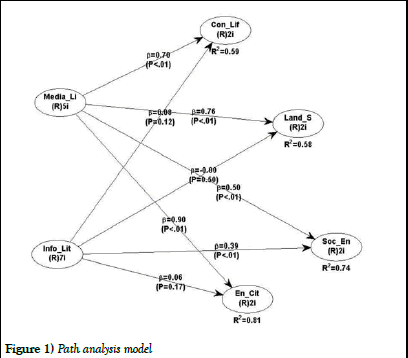
Figure 1) Path analysis model
This study examined the predictive influence of media literacy and information literacy on environmental stewardship behaviors among college students through structural equation modeling.
The findings revealed that students demonstrated satisfactory levels of conservation lifestyle, land stewardship, social environmental engagement, and environmental citizenship. These results indicate a positive orientation toward environmental responsibility and sustainability.
The measurement model exhibited strong reliability, convergent validity, discriminant validity, and acceptable collinearity statistics, confirming the robustness of the analytical framework.
Media literacy emerged as a significant predictor of all dimensions of environmental stewardship behavior. Students who possessed stronger media literacy skills were more likely to engage in conservation activities, habitat stewardship, environmental collaboration, and environmental citizenship.
Information literacy demonstrated a significant influence on social environmental engagement but did not significantly predict other environmental stewardship dimensions. This finding suggests that information literacy supports environmental participation primarily through communication and collaborative activities.
Overall, the study demonstrates that literacy competencies play an important role in shaping environmental behavior. Strengthening media literacy and information literacy within higher education may contribute to the development of environmentally responsible citizens capable of supporting biodiversity conservation, ecosystem protection, and sustainable development.
The researcher considers it a very great privilege and expresses her highest appreciation and gratitude to the J.H. Cerilles State College President, Dr. Edgardo H. Rosales; Office of the Vice President for Research, Extension, and Resource Generation, and Dumingag Campus Director, Dr. Moises Glenn Tangalin, for the support and encouragement to further enhance professional competencies of their faculty members.
Received: 15-Apr-2026, Manuscript No. AGBIR-26-192573; , Pre QC No. AGBIR-26-192573 (PQ); Editor assigned: 17-Apr-2026, Pre QC No. AGBIR-26-192573 (PQ); Reviewed: 01-May-2026, QC No. AGBIR-26-192573; Revised: 15-Jun-2026, Manuscript No. AGBIR-26-192573 (R); Published: 22-Jun-2026, DOI: 10.37532/0970-1907.26.42(1):1-9