
An International Journal
Agricultural and Biological Research
ISSN - 0970-1907
RNI # 24/103/2012-R1
RNI # 24/103/2012-R1
Research Article - (2026) Volume 42, Issue 1
This study investigated the economic feasibility of hydroponic lettuce production using locally sourced organic inputs, specifically Fermented Plant Juice (FPJ) for food security in the Zamboanga Peninsula, employing experimental method. Hydroponics is seen as beneficial for addressing space limitations and improving food security in the region, though adoption is hindered by limited technical knowledge, material access, and capital. Estrosa and Olmetie lettuce varieties showed optimal performance. Nitrate levels in Estrosa and Green Wave were undetectable, and while Olmetie and Invicta absorbed more nitrate with FPJ, all levels remained within international safety limits. Cadmium was not detected. Recommendations for the Zamboanga Peninsula include agricultural modernization through technical training, start-up assistance, material accessibility, and R and D support. Public awareness campaigns for low-cost hydroponics using FPJ, crop diversification, farmer engagement, and urban/peri-urban adoption incentives are also suggested. Growers are advised to prioritize Estrosa and Green Wave for lower nitrate uptake and ensure correct FPJ preparation.
Fermented plant juice; Sustainable lettuce production; Urban farming, Zamboanga Peninsula
Global food security is challenged by conventional farming limitations and increasing urban populations, with Philippine urban and peri-urban areas experiencing reduced food production due to land conversion, leading to food insecurity. Hydroponic systems, a soil-less method, offer a viable solution for localized food production, enabling year-round cultivation, water conservation, and reduced chemical use. While the Philippines supports hydroponics through initiatives like the National Urban and Periurban Agriculture Program (NUPAP), adoption is limited by barriers including high start-up costs, lack of technical know-how, and concerns about nutrient solution affordability. The development of low-cost hydroponic systems using locally available materials such as Fermented Plant Juice (FPJ) is emerging as a promising alternative.
While numerous studies have validated the efficacy of Fermented Plant Juices (FPJ) in traditional, soil-based crop production systems, limited attention has been directed towards understanding its application within hydroponic environments. The study further aims to investigate the practicability of applying Fermented Plant Juices (FPJ) within hydroponic systems to enhance lettuce cultivation. This exploration seeks to offer insights into alternative, more sustainable approaches to lettuce production, aligning with evolving consumer preferences for healthier and environmentally friendly food options.
This study addressed food safety concerns related to nitrate and cadmium accumulation in lettuce, which is often consumed raw and accumulates these substances from intensive fertilization or contaminated environments. Nitrates can convert to nitrites in the body, linked to health issues, while cadmium is a toxic heavy metal classified as a human carcinogen. The research integrated the use of fermented plant juice into low-cost hydroponics in the Zamboanga Peninsula. This involved an experimental study comparing lettuce growth and yield with different nutrient solutions (analyzing cadmium and nitrate levels). The research aims to support UN Sustainable Development Goals by providing scientific evidence for scalable, cost-effective, and safe food production systems, examining technical, social, economic, and policy dimensions.
Objectives
This research sought to study the use of fermented plant juice for sustainable lettuce production in urban planning among farmers in Zamboanga Peninsula during the calendar year 2024.
The study specifically aims to:
• Identify the effects of different nutrient hydroponic solutions, including Fermented Plant Juice (FPJ), on the horticultural characteristics, yield performance, and profitability of selected leafy lettuce varieties produced under hydroponic systems; and
• Determine the cadmium and nitrate concentrations in harvested lettuce.
The study employed experimental design. The study was conducted in Zamboanga Peninsula with an established greenhouse which served as experimental laboratory within the property of the Department of Agriculture Regional Field Unit 9 located at Lenienza, Pagadian City. The experiment on the cultivars of lettuce using low-cost hydroponic system was conducted from July to October 2024 and thereafter, data were gathered on lettuce samples.
The experiment employed a factorial research design in a Completely Randomized Design (CRD) setup to determine the effects of different types of nutrient hydroponic solutions and lettuce varieties on growth characteristics, yield performance, economic returns and cadmium and nitrate concentrations.
The study used seeds of Lettuce (Lactuca sativa L.), germinated inside the greenhouse structure with these specifications (10 × 6 × 12 meters) with UV film roofing (200 um) and 40-60 shade from nearby trees in the property. It has germinated 300 seed to each of the four (4) varieties of lettuce: Olmetie, Invicta, Estrosa and Green Wave. Likewise, the experiment used 60 plastic hydroponic boxes as experiment units, on two elevated tables inside the greenhouse, 840 hydroponic cups, 4 pieces of big water containers, pails, coco peat, water resources, water quality meter/tester, and measuring tools (ruler/caliper and digital weighing scale). Water solutions are enriched with prepared fermented plant juice, commercial NHS and mixed of the latter and the FPJ at varying levels. Finally, the experiment site with a total area of 60 square meters was accommodated.
The experiment was laid out in a 4 X 5 Factorial arranged in Complete Randomize (CRD), where Factor A, represents the varieties of lettuce. The nutrient hydroponic solutions with 5 types/formula served as Factor B. The experiment has twenty (20) treatments each replicated three (3) times. This design allows for the simultaneous investigation of the independent effects of FPJ and synthetic NHS and lettuce varieties, as well as potential interactions between these factors. As indicated:
Factor A: Lettuce loose leaf varieties
Variety 1: Olmetie Batavia Lettuce
Variety 2: Invicta Rz
Variety 3: Estrosa
Variety 4: Green Wave
Factor B: Synthetic-based and FPJ-based Nutrient Solutions
Level 1: Commercial NHS
Level 2: 25% FPJ Nutrient Solution and 75% Commercial NHS
Level 3: 50% FPJ Nutrient Solution and 50% Commercial NHS
Level 4: 75% FPJ Nutrient Solution and 25% Commercial NHS
Level 5: FPJ-based Nutrient Solution (100% FPJ)
The treatments and treatment combinations are presented in Table 1.
| Varieties of lettuce | Hydroponic nutrient solution | Treatment combinations (Codes) | Treatments |
| Commercial NHS (B1) | A1B1 | T1 | |
| Olmetie Batavia Lettuce (A1) | 25% FPJ Nutrient Solution and 75% Commercial NHS (B2) | A1B2 | T2 |
| 50% FPJ Nutrient Solution and 50% Commercial NHS (B3) | A1B3 | T3 | |
| 75% FPJ Nutrient Solution and 25% Commercial NHS (B4) | A1B4 | T4 | |
| 100% FPJ (B5) | A1B5 | T5 | |
| Invicta Rz (A2) | Commercial NHS (B1) | A2B1 | T6 |
| 25% FPJ Nutrient Solution and 75% Commercial NHS (B2) | A2B2 | T7 | |
| 50% FPJ Nutrient Solution and 50% Commercial NHS (B3) | A2B3 | T8 | |
| 75% FPJ Nutrient Solution and 25% Commercial NHS (B4) | A2B4 | T9 | |
| 100% FPJ (B5) | A2B5 | T10 | |
| Estrosa (A3) | Commercial NHS (B1) | A3B1 | T11 |
| 25% FPJ Nutrient Solution and 75% Commercial NHS (B2) | A3B2 | T12 | |
| 50% FPJ Nutrient Solution and 50% Commercial NHS (B3) | A3B3 | T13 | |
| 75% FPJ Nutrient Solution and 25% Commercial NHS (B4) | A3B4 | T14 | |
| 100% FPJ (B5) | A3B5 | T15 | |
| Green Wave (A4) | Commercial NHS (B1) | A4B1 | T16 |
| 25% FPJ Nutrient Solution and 75% Commercial NHS (B2) | A4B2 | T17 | |
| 50% FPJ Nutrient Solution and 50% Commercial NHS (B3) | A4B3 | T18 | |
| 75% FPJ Nutrient Solution and 25% Commercial NHS (B4) | A4B4 | T19 | |
| 100% FPJ (B5) | A4B5 | T20 |
TABLE 1 Treatment and treatment combinations of the study
The planting materials used consisted of certified lettuce seeds of four (4) varieties, namely Olmetie, Invicta (Batavia), Estrosa and Green Wave, procured from accredited seed suppliers. The hydroponic system was set up using the “Kratky Method” container-based (hydroponic box) units with a capacity of 16 liters served as nutrient reservoirs. All these hydroponic box were settled in constructed low-cost greenhouse using bamboo poles, UV film, garden nets.
In this study, cadmium and nitrate concentrations in fresh lettuce were analyzed to assess food safety compliance and potential health risks, especially in relation to the use of different nutrient solutions.
Data from the experiment were subjected to factorial two-way ANOVA in determining the differences among the samples and post-hoc test (HSD) using Starr software.
Growth and yield
This study assessed the impact of different hydroponic nutrient solutions on the horticultural characteristics and yield of leafy lettuce (Lactuca sativa L.) varieties. The research focuses on key growth parameters like leaf number, leaf area, weight, and overall yield to determine optimal nutrient formulations for enhancing both quality and quantity in controlled hydroponic environments. The findings are intended to guide growers, particularly in urban settings, who are utilizing hydroponics for sustainable food production.
Analysis of four lettuce varieties (Olmetie, Invicta, Estrosa, Green Wave) in hydroponics across two cycles revealed significant genetic differences in growth. Estrosa produced the most leaves, while Green Wave produced the fewest, with variety being a primary driver of leaf number rather than nutrient solutions within the tested ranges. Leaf length and width were significantly influenced by both variety and nutrient treatments. Invicta consistently yielded the longest leaves, and 100% Commercial Nutrient Hydroponic Solution (NHS) produced the longest leaves overall. Combinations of Commercial NHS with Fermented Plant Juice (FPJ) showed potential, with specific ratios (e.g., 75% Commercial NHS+25% FPJ) demonstrating synergistic effects on leaf width in later cycles (Table 2).
| Treatments | 1st cycle | 2nd cycle | ||||
| Number of leaves | Leaf length (cm) | Leaf width (cm) | Number of leaves | Leaf length (cm) | Leaf width (cm) | |
| Varieties | ||||||
| Olmetie | 14b | 13.26c | 12.24a | 14b | 11.62b | 11.27a |
| Invicta | 12c | 17.06a | 12.75a | 12c | 13.72a | 11.49a |
| Estrosa | 16a | 15.3b | 12.87a | 16a | 13.77a | 11.46a |
| Green Wave | 9d | 13.06c | 8.39b | 9d | 11.18b | 9.18b |
| F Test A | ** | ** | ** | ** | ** | ** |
| Levels of Nutrient Hydroponic Solutions (NHS) | ||||||
| 100% Commercial NHS | 13 | 16.01a | 12.46 | 13 | 13.47 | 11.42ab |
| 75% Commercial NHS + 25% FPJ | 13 | 15.41ab | 11.87 | 13 | 12.08 | 11.59a |
| 50% Commercial NHS + 50% FPJ | 13 | 14.26bc | 11.52 | 13 | 11.86 | 10.31c |
| 75% FPJ + 25% Commercial NHS | 13 | 14.40bc | 11.12 | 13 | 13.06 | 10.54bc |
| 100% Fermented Plant Juice (FPJ) | 13 | 13.35c | 10.85 | 13 | 12.42 | 10.39c |
| F Test B | Ns | ** | ns | ns | ns | * |
| A x B | Ns | ** | ** | ns | ** | ** |
| CV% | 0.1 | 2.51 | 5.6 | |||
| Note: Means followed by the same letter (s) are not significantly different on the HSD test **Significant at 1% level of probability *Significant at 5% level of probability ns=not significant |
||||||
TABLE 2 Number, length and width of leaves of lettuce varieties applied with different levels of Nutrient Hydroponic Solutions (NHS)
Interaction between varieties and nutrient treatments on growth
The interaction between varieties and nutrient treatments (A × B) was significant at 1% probability level for leaf length and leaf width in the 1st cycle, and for leaf length in the 2nd cycle, indicating that the growth response to nutrient solutions is variety-dependent. This finding corroborates with the research by Samarakoon et al. [1], who emphasized the genotype × nutrient environment interaction in hydroponic leafy vegetables, suggesting that nutrient formulations should be variety-specific to optimize productivity.
This also echoes the study by Ezzidine et al. [2] which revealed that “The yield of lettuce (kg m-2) grown in ONS was comparable to the yield of lettuce grown in CNS. Except for Mg and Mn, comparable and even higher content of nutritionally minerals were found in the leaves of lettuce grown in organic fertilizer compared to the lettuce grown in conventional fertilizer”.
Table 3 details the interaction effect of lettuce varieties and Nutrient Hydroponic Solutions (NHS) on leaf length across two cropping cycles. Both factors significantly impacted leaf length, with Invicta consistently producing the longest leaves, reaching 18.23 cm in the first cycle and 16.19 cm in the second, particularly at 100% commercial NHS and showing good results with FPJ supplementation. Estrosa also demonstrated adaptability, with notable growth at 50% commercial NHS+50% FPJ in the second cycle. Olmetie and Green Wave generally had shorter leaves, though Green Wave showed improvement with moderate organic supplementation. Leaf length reductions between cycles may be due to environmental variations or nutrient depletion. These findings align with studies by Chowdhury et al. [3] on hydroponic systems and Garcia [4] on fermented plant juice, suggesting that Invicta and Estrosa are suitable for reduced commercial nutrient inputs via FPJ, offering cost-saving sustainable practices for marketability.
| Levels of Nutrient Hydroponic Solutions (NHS) | ||||||||||
| Varieties | 100% commercial NHS | 75% commercial NHS+25% FPJ | 50% commercial NHS+ 50% FPJ | 75% FPJ+25% commercial NHS | 100% Fermented Plant Juice (FPJ) | |||||
| 1st | 2nd | 1st | 2nd | 1st | 2nd | 1st | 2nd | 1st | 2nd | |
| Olmetie | 14.85c | 12.57c | 13.55b | 10.79c | 12.85c | 10.18c | 12.85c | 12.75b | 12.21c | 11.81c |
| Invicta | 18.23a | 16.19a | 17.50a | 12.42b | 17.31a | 11.50b | 17.18a | 14.60a | 15.06a | 13.88a |
| Estrosa | 17.47b | 13.72b | 17.13a | 13.74a | 14.24b | 14.56a | 14.61b | 14.03a | 13.04b | 12.82b |
| Green Wave | 13.48d | 11.39d | 13.48b | 13.36c | 12.62c | 11.18b | 12.94 | 10.85c | 13.10b | 11.15c |
| Note: Means followed by the same letter (s) are not significantly different on the HSD test | ||||||||||
TABLE 3 Interaction effects on the length of leaves of lettuce varieties applied with different levels of Nutrient Hydroponic Solutions (NHS) in the 1st and 2nd cycles
As shown in Table 4, the interaction between lettuce variety and the levels of Nutrient Hydroponic Solutions (NHS) during the 2nd cycle indicated significant variations in leaf width. The Olmetie variety attained its widest leaves (12.27 cm) under 100% commercial NHS, followed closely by 75% FPJ+25% commercial NHS (11.28 cm) and 100% FPJ (11.11 cm). This suggests that while Olmetie benefits most from full commercial nutrient supply, it can still maintain relatively wide leaves under higher FPJ inclusion.
| Levels of Nutrient Hydroponic Solutions (NHS) | |||||
| Varieties | 100% commercial NHS | 75% commercial NHS+25% FPJ | 50% commercial NHS+50% FPJ | 75% FPJ+ 25% commercial NHS | 100% Fermented Plant Juice (FPJ) |
| Olmetie | 12.27a | 11.73b | 9.99b | 11.28a | 11.11a |
| Invicta | 12.02a | 12.55a | 10.93a | 10.77a | 11.18a |
| Estrosa | 11.87a | 12.80a | 11.13a | 11.07a | 10.45b |
| Green Wave | 9.53b | 9.29c | 9.20c | 9.06b | 8.81c |
| Note: Means followed by the same letter (s) are not significantly different on the HSD test | |||||
TABLE 4 Interaction effect of the leaf width (cm) of lettuce varieties applied with different levels of Nutrient Hydroponic Solutions (NHS) in the 2nd cycle
For Invicta, the widest leaves (12.55 cm) were recorded under 75% commercial NHS+25% FPJ, slightly surpassing the width achieved under 100% commercial NHS (12.02 cm). This indicates that Invicta may respond positively to moderate FPJ supplementation, possibly due to the additional organic metabolites in FPJ that enhance leaf expansion. Estrosa showed a similar trend, with the widest leaves (12.80 cm) under 75% commercial NHS+25% FPJ, suggesting that partial substitution of commercial solutions with FPJ could enhance leaf development.
In contrast, Green Wave consistently exhibited the narrowest leaves across all treatments, with its highest measurement (9.53 cm) still significantly lower than other varieties. This implies inherent varietal limitations in leaf expansion, regardless of nutrient solution composition.
The statistical groupings from the HSD test reinforce that the effect of nutrient solution composition is variety-dependent.
Upon closer interpretation, the varieties of Lettuce interaction effect in terms of leaf width showed great potential for a 100% Fermented Plant Juice (FPJ) as nutrient at 11.11a, 11.18a, 10.45b, and 8.81c respectively which are performing at par with the commercial NHS which is very expensive to procure. This data showed that with this difference, the promise brought about by the FPJ as a nutrient solution which is cost-effective because it will not cost so much is a viable alternative to commercial NHS which echoes in the study that claimed that “that lettuce plants grown with organic NS derived from fish waste had lower plant height, leaf number and area, fresh biomass, and stomatal density compared to inorganically grown plants, while the total chlorophyll, chlorophyll a, carotene, phenolic compounds, and flavonoid content as well as antioxidant activity were higher in plants grown in the organic solution compared to the inorganic ones, reflecting the nutritive value of the former. In contrast to N, potassium accumulation was significantly higher in inorganically grown plants compared to those grown in the organic solution. The difference in yield parameters between the two solutions was explained by the availability of mineral nutrients to the plants being lower in the organic solution.” [5].
However, the findings also suggested that while full commercial NHS promotes uniform leaf width in most varieties, a 75% commercial+25% FPJ mix may optimize leaf expansion in certain cultivars such as Invicta and Estrosa. This has both economic and sustainability implications, as integrating FPJ reduces reliance on costly synthetic nutrient solutions without markedly reducing morphological quality.
Also, a study on lettuce production through hydroponics using commercially available solutions has revealed that there is no significant difference in its performance [6] and so an option such as the FPJ is a suitable alternative to cut cost and to propagate lettuce in a low-cost hydroponic system.
Fresh weight is a primary yield indicator in leafy vegetable production and a direct measure of biomass accumulation influenced by both genetic and environmental factors, including nutrient availability. Table 2 presents the fresh weight performance of four lettuce varieties subjected to different levels of Nutrient Hydroponic Solutions (NHS) over two cropping cycles (Table 5).
| Treatments | 1st cycle | 2nd cycle | |
| Fresh weight (gram) | |||
| Varieties | |||
| Olmetie | 36.02a | 37.28a | |
| Invicta | 32.09b | 30.29b | |
| Estrosa | 37.76a | 31.05b | |
| Green Wave | 26.80c | 25.78c | |
| F Test A | ** | ** | |
| Levels of Nutrient Hydroponic Solutions (NHS) | |||
| 100% Commercial NHS | 39.13a | 35.32a | |
| 75% Commercial NHS + 25% FPJ | 34.59b | 33.09a | |
| 50% Commercial NHS + 50% FPJ | 31.37b | 31.35ab | |
| 75% FPJ + 25% Commercial NHS | 30.55b | 28.04b | |
| 100% Fermented Plant Juice (FPJ) | 30.19b | 27.69b | |
| F Test B | ** | ** | |
| A x B | ** | ** | |
| CV% | 2 | 1.91 | |
| Note: Means followed by the same letter (s) are not significantly different on the HSD test ** = Significant at 1% level of probability |
|||
TABLE 5 Fresh weight of different varieties applied with different levels of Nutrient Hydroponic Solutions (NHS)
Across both cropping cycles, the results revealed highly significant varietal differences (F Test A: significant at 1% probability level). In the first cycle, Estrosa produced the highest fresh weight, confirming its superior growth performance among the varieties tested. In the second cycle, Olmetie outperformed the other varieties in terms of fresh weight, although both Estrosa and Olmetie consistently demonstrated superior performance compared to the other varieties across both cycles. Specifically, in the first cycle, Estrosa recorded the highest fresh weight at 37.76 grams, which was statistically comparable to Olmetie at 36.02 grams. Conversely, Green Wave consistently produced the lowest fresh weight at 26.80 grams.
A similar trend was evident in the second cycle, where Olmetie produced the highest fresh weight (37.28 grams), followed closely by Estrosa (31.05 grams). Green Wave remained the least productive variety in terms of fresh biomass. These results affirm the superior and stable performance of Estrosa and Olmetie under the tested nutrient solution levels, making them the more promising varieties for hydroponic lettuce production in urban and peri-urban settings.
The data suggest that lettuce growth in a hydroponic system was primarily influenced by root morphology and nutrient solution flow. Research indicates that a suitable flow rate can mechanically stimulate plants (thigmomorphogenesis), promoting root growth by providing eustress. Enhanced root growth improves nutrient absorption and overall plant development. Conversely, excessive flow rates can be detrimental, causing roots to become compact, reducing surface area, and hindering growth, thereby impacting nutrient uptake and plant health compared to optimal conditions.
The application of different NHS levels also exhibited highly significant effects on fresh weight (F Test B: significant at 1% probability level) in both cycles. In both the 1st and 2nd cycles, the 100% Commercial NHS treatment produced the highest fresh weight (39.13 grams and 35.32 grams, respectively), significantly outperforming other treatments.
Partial replacement of Commercial NHS with Fermented Plant Juice (FPJ) at 25% substitution (75% Commercial NHS+25% FPJ) resulted in slightly reduced but still competitive fresh weights (34.59 grams in the 1st cycle, 33.09 grams in the 2nd). However, increasing FPJ content beyond 50% led to a progressive decline in fresh weight, with 100% FPJ recording the lowest values (30.19 grams and 27.69 grams, respectively).
This outcome substantiates the findings of Almeyadi, et al. [7] who demonstrated that while plant-based organic nutrient solutions can partially substitute synthetic hydroponic fertilizers, complete replacement significantly reduces yield due to potential nutrient imbalances or insufficiencies in macronutrients critical for leaf biomass development, particularly nitrogen.
The interaction between lettuce varieties and nutrient treatments (A × B) was also found to be highly significant (at 1% probability level) in both cropping cycles. This indicates that the response of each variety to the different NHS levels varied considerably, confirming that nutrient formulation efficacy is genotype-specific.
This finding too support the contention that bio-products as nutrients in hydroponics is a viable option to pursue to allow the technology to be adapted at a low-cost. A study revealed that “demonstrated that the bioproduct can serve as an effective and eco-friendly alternative to conventional hydroponic nutrient solutions, especially for organic production. The results highlight the potential of bio-products to support sustainable agricultural practices, reduce dependency on synthetic fertilizers, and improve the quality of crops grown in hydroponic systems.” [8].
Table 6 specifically, presents the interaction effects of lettuce variety and different levels of Nutrient Hydroponic Solutions (NHS) on fresh weight during the first and second cropping cycles. The results show significant differences, indicating that both varietal characteristics and nutrient solution composition play a major role in determining biomass accumulation.
| Levels of Nutrient Hydroponic Solutions (NHS) | ||||||||||
| Varieties | 100% commercial NHS | 75% commercial NHS+25% FPJ | 50% commercial NHS+50% FPJ | 75% FPJ+ 25% commercial NHS | 100% Fermented Plant Juice (FPJ) | |||||
| 1st | 2nd | 1st | 2nd | 1st | 2nd | 1st | 2nd | 1st | 2nd | |
| Olmetie | 50.93a | 45.29a | 40.68a | 44.18a | 31.24b | 39.58a | 28.88c | 28.98a | 28.35c | 28.36a |
| Invicta | 35.20c | 31.92c | 31.58c | 30.81b | 31.65b | 30.20b | 31.92b | 29.65a | 30.09b | 28.87a |
| Estrosa | 42.58b | 36.82b | 38.29b | 30.74b | 36.38a | 29.84b | 35.11a | 28.81a | 36.46a | 29.04a |
| Green Wave | 27.82d | 27.24d | 27.82d | 26.64c | 26.19c | 25.80c | 26.30d | 24.72b | 25.85d | 24.48b |
| Note: Means followed by the same letter (s) are not significantly different on the HSD test | ||||||||||
TABLE 6 Interaction effects on the fresh weight of lettuce varieties applied with different levels of Nutrient Hydroponic Solutions (NHS) in the 1st and 2nd cycles
In the 1st cycle, Olmetie recorded the highest fresh weight (50.93 g) under 100% commercial NHS, significantly outperforming other variety– treatment combinations. Even when supplied with 75% commercial NHS+ 25% FPJ (40.68 g), Olmetie maintained a competitive biomass yield. However, reductions were observed as the proportion of FPJ increased, with the lowest weight under 100% FPJ (28.35 g). Interestingly, in the 2nd cycle, although fresh weights were generally lower across varieties, Olmetie maintained high performance across treatments, with no significant differences detected in several FPJ-inclusive treatments, suggesting adaptability to alternative nutrient sources.
Estrosa also exhibited strong performance, particularly under 50% commercial NHS+50% FPJ in the 1st cycle (36.38 g) and 100% commercial NHS (42.58 g), indicating good flexibility to partial organic supplementation. In contrast, Invicta, which had the highest leaf length in previous tables, did not achieve the highest fresh weight, with its best performance (35.20 g) under full commercial NHS in the 1st cycle. This suggests that morphological advantages (e.g., leaf length) do not always translate directly into greater biomass, as biomass accumulation also depends on leaf thickness, density, and water content [9].
Green Wave consistently recorded the lowest fresh weight across all treatments and cycles, with a maximum of 27.82 g in the 1st cycle under full commercial NHS. This reinforces earlier observations from leaf length and width data that Green Wave’s genetic potential for vegetative biomass is inherently lower, regardless of nutrient composition.
Across cycles, fresh weight tended to be lower in the 2nd cycle for most combinations. This decline may be due to environmental variations such as temperature and light intensity inside the greenhouse, nutrient solution temperature effects, or the physiological limits of the reused substrate. The interaction patterns indicate that Olmetie and Estrosa are better candidates for high-yield production when aiming for both commercial NHS efficiency and partial organic integration.
Cost and return of producing leafy varieties of lettuce applied with different nutrient hydroponic solution
The profitability of hydroponic vegetable production systems is highly dependent on both production costs and market returns. In this study, a comprehensive cost and return analysis was conducted to evaluate the economic performance of producing different leafy lettuce varieties under various nutrient hydroponic solution formulations. This analysis aimed to determine which combinations of variety and nutrient management would yield the highest financial returns, thereby providing insights for growers and investors seeking to optimize profitability in hydroponic farming ventures. The following graph presents a summary of the Return On Investment (ROI) for each treatment combination, highlighting the economic viability of each production setup tested (Figure 1).
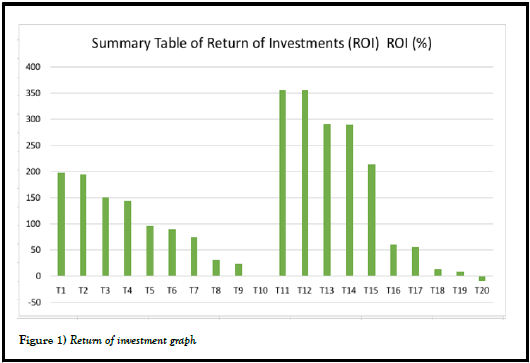
Figure 1) Return of investment graph
The graph indicates the Return of Investment (ROI) percentages for twenty different treatments (T1 through T20), demonstrating a wide range of financial outcomes.
The hydroponic lettuce production revealed significant variations in profitability influenced by two major factors: the lettuce variety used (Factor A) and the nutrient hydroponic solution formulation (Factor B). Four lettuce varieties were tested: Olmetie (T1–T5), Invicta (T6–T10), Estrosa (T11–T15), and Green Wave (T16–T20). Alongside this, five nutrient solution formulations were employed, namely: 100% commercial Nutrient Hydroponic Solution (NHS) for T1, T6, T11, and T16; 75% Commercial NHS mixed with 25% Fermented Plant Juice (FPJ) for T2, T7, T12, and T17; a 50-50 mix for T3, T8, T13, and T18; 25% commercial NHS with 75% FPJ for T4, T9, T14, and T19; and 100% FPJ for T5, T10, T15, and T20.
The highest ROI observed is 355.91% for T12, closely followed by T11 at 355.63%, indicating significant profitability for these treatments. Conversely, T20 shows a negative ROI of -8.08%, meaning this treatment resulted in a financial loss. The graph further suggests that treatments T11, T12, T13, T14 and T15 are highly effective, while T20 proved to be a losing venture.
The findings showed that the Estrosa variety demonstrated the highest profitability potential, particularly when grown using either 100% commercial NHS or a 75% NHS and 25% FPJ mixture. Treatment T11 (100% NHS) and T12 (75/25 NHS-FPJ) achieved ROI values of 355.63% and 355.91%, respectively, substantially outperforming all other treatment combinations. This result indicates the strong adaptability of Estrosa to hydroponic systems, coupled with its capacity to respond well to nutrient solutions rich in synthetic commercial formulations, while still maintaining profitability when partially supplemented with organic FPJ. This observation aligns with the findings of Du Jardin [10], who emphasized that variety selection and nutrient management significantly influence the profitability and productivity of hydroponic vegetable production systems.
The Olmetie variety followed as the second most profitable, achieving ROI values of 197.97% and 195.06% for T1 (100% NHS) and T2 (75/25 NHSFPJ), respectively. However, profitability began to decline as the proportion of FPJ in the nutrient mix increased, with a noticeable drop to 96.64% ROI under T5, which used 100% FPJ. This suggests that while Olmetie can thrive in nutrient-rich solutions, its performance deteriorates when synthetic nutrients are fully replaced by organic alternatives.
On the other hand, the Invicta variety yielded more modest returns. Its highest ROI was 90.71% under T6 (100% NHS), with a steady decline across treatments as FPJ content increased, ultimately dropping to near breakeven levels (0.11%) under T10 (100% FPJ). This demonstrates that Invicta has limited economic suitability in hydroponic systems compared to Olmetie and Estrosa, particularly when using organic or low-synthetic nutrient regimes. The poorest performance was recorded for the Green Wave variety, with its highest ROI at only 61.67% under T16 (100% NHS). Like the other varieties, profitability dropped progressively as the proportion of FPJ increased, ultimately resulting in a financial loss of -8.08% at T20 (100% FPJ).
The study illustrates that the combined effects of lettuce variety and nutrient formulation considerably affect the financial viability of hydroponic systems. The Estrosa variety, when supplied with 100% commercial NHS or a 75/25 NHS-FPJ mixture, emerged as the most economically viable combination. The findings also confirm that while partial organic supplementation is feasible, complete replacement of commercial nutrients with FPJ significantly compromises profitability. Future ventures into hydroponic lettuce production should therefore prioritize high-performing varieties like Estrosa, paired with optimized nutrient solution strategies, to maximize economic returns.
Cadmium and nitrate concentrations and other tests
This experiment assessed the safety and nutritional quality of hydroponically grown lettuce by analyzing nutrient concentrations in water solutions (commercial NHS vs. Fermented Plant Juice) and residues in harvested lettuce, specifically nitrates and cadmium. Monitoring these parameters is crucial for food safety compliance and evaluating the environmental sustainability of soilless culture systems, as high nitrates pose health risks and cadmium bio-accumulates. The study aimed to determine if different Nutrient Hydroponic Solutions (NHS) and lettuce varieties resulted in acceptable levels of these elements, aligning with safety thresholds and agronomic standards. Table 3 details the NPK levels in both commercial and FPJ water solutions used in the experiment.
Nutrient analysis of hydroponic solutions showed variations between commercial and Fermented Plant Juice (FPJ)-based formulations, particularly in Nitrogen (N), Phosphorus (P), and Potassium (K) levels. The commercial solution had slightly higher total nitrogen (0.0716%) compared to the FPJ-based solution (0.0627%), with both being sufficient for leafy crop growth, aligning with optimal hydroponic nitrogen concentrations (50-200 ppm). Both solutions tested "Not detected" for phosphorus, suggesting potential limitations due to low solubility or extraction inefficiency, consistent with observations of lower phosphorus concentrations in organic liquid fertilizers compared to inorganic ones due to slower breakdown and limited water solubility. This indicates a need for supplementary phosphorus or FPJ formulation optimization for balanced hydroponic nutrition (Table 7).
| Parameters | Unit | Commercial NHS | FPJ | Test method |
| Total Nitrogen | % | 0.0716 | 0.0627 | Kjeldahl |
| Phosphorus as P2O5 | % | Not detected | Not detected | Colorimetry |
| Potassium as K2O | % | 0.04 | 0.058 | Flame AAS |
TABLE 7 NPK levels tested both for commercial and FPJ water solutions used to grow lettuce in the experiment
The FPJ-based solution (0.058%) showed a greater potassium concentration than commercial NHS (0.040%), suggesting FPJ's effectiveness in extracting potassium from plant sources. Potassium is vital for plant water balance, stomatal function, and health, with its levels being particularly important in hydroponics for cell turgidity and nutrient transport. The higher potassium content in FPJ indicates its potential as a supplementary or alternative potassium source for nutrient solutions, especially for leafy vegetables with high potassium requirements (Table 8).
| Parameters | Unit | Commercial NHS | FPJ | Growing medium | Test method |
| Cadmium | mg/kg | Not detected | Not detected | Not detected | Flame AAS |
TABLE 8 Laboratory test results of cadmium traces in water solutions and growth medium used in growing lettuce of the experiment
Traces of Cadmium were not detected in water solutions treated with commercial NHS and FPJ, as shown in Table 9. This absence of cadmium, a toxic heavy metal, in hydroponic nutrient solutions is a positive food safety outcome. These findings indicate FPJ's potential as a sustainable hydroponic nutrient source, supporting the UN's Sustainable Development Goals for Zero Hunger and Responsible Consumption and Production.
| Parameters | Unit | Sample treatments | Test method | |
| Cadmium | mg/kg | T1 | Not detected | Flame AAS |
| T5 | Not detected | |||
| T6 | Not detected | |||
| T10 | Not detected | |||
| T11 | Not detected | |||
| T15 | Not detected | |||
| T16 | Not detected | |||
| T20 | Not detected | |||
TABLE 9 Laboratory test results of cadmium traces in fresh lettuce samples per treatment
Analysis of fresh lettuce samples using Flame Atomic Absorption Spectrophotometry (Flame AAS) revealed no detectable cadmium (Cd). This indicates that the hydroponic nutrient solutions and production materials used were free from cadmium contamination, aligning with international food safety standards (Codex Alimentarius 2019) maximum permissible level of 0.2 mg/kg fresh weight for leafy vegetables). These findings are consistent with previous studies demonstrating the safety of hydroponically grown vegetables when using clean water and controlled nutrient solutions. Hydroponics, as a controlled soilless system, significantly reduces the risk of heavy metal contamination compared to open field production, particularly in polluted areas, offering a viable alternative for producing safer vegetables (Table 10).
| Parameter | Varieties | NHS applied | Nitrate as sodium nitrate (ppm) | Test method |
| Nitrate as sodium nitrate | Olmetie (T1) | 100% Commercial | 28.48 | AOAC |
| Olmetie (T5) | 100% FPJ | 260.9 | ||
| Invicta (T6) | 100% Commercial | Not detected | ||
| Invicta (T10) | 100% FPJ | 206.32 | ||
| Estrosa (T11) | 100% Commercial | Not detected | ||
| Estrosa (T15) | 100% FPJ | Not detected | ||
| Green Wave (T16) | 100% Commercial | Not detected | ||
| Green Wave (T20) | 100% FPJ | Not detected | ||
| Note: Not Detected=(LOD=0.0) | ||||
TABLE 10 Laboratory test results of nitrate concentrations in fresh lettuce applied with commercial and fermented plant juice NHS
Laboratory analysis of nitrate concentrations in fresh lettuce treated with commercial Nutrient Hydroponic Solution (NHS) and Fermented Plant Juice (FPJ) revealed significant variations. The Olmetie variety treated with 100% FPJ (T5) had the highest concentration at 260.90 ppm, followed by the Invicta variety with FPJ (T10) at 206.32 ppm, and Olmetie with 100% NHS (T1) at 28.48 ppm. Other treatments registered below the limit of detection (0.1 ppm). The study indicates that both lettuce variety and nutrient source substantially affect nitrate accumulation; Olmetie and Invicta varieties were highly responsive to FPJ, while Estrosa and Green Wave varieties showed consistently undetectable nitrate levels regardless of the nutrient source. Factors such as delayed harvesting and FPJ application practices might contribute to elevated nitrate. All samples were found to be below the European Commission's Maximum Residue Limits (MRLs) for nitrate, thus considered safe for consumption, underscoring the importance of appropriate nutrient management and variety selection for crop quality.
The study found that lettuce variety selection and nutrient formulation significantly impact growth, yield, and profitability. Estrosa and Olmetie varieties showed superior performance. Nutrient solution at 100%
Commercial NHS yielded the best results, with partial substitution (25%) of Fermented Plant Juice (FPJ) maintaining satisfactory growth and economic returns; higher FPJ levels negatively affected yield. Nutrient management should be variety-specific. Nitrate accumulation varied by variety and nutrient source, with Olmetie and Invicta showing higher uptake when treated with FPJ, reaching up to 260.90 ppm. Estrosa and Green Wave consistently showed no detectable nitrate, regardless of treatment, suggesting their suitability for low-nitrate production. All detected nitrate levels were below international safety limits. Cadmium was not detected in any samples, confirming the safety and marketability of the lettuce produced through both organic and inorganic nutrient applications.
Key suggestions include information campaigns on low-cost FPJ-based hydroponics, diversifying plant varieties beyond lettuce, involving farmers in addressing challenges for best practices, and incentivizing hydroponics in urban settings for nutritional produce. Lettuce farmers should choose varieties with high nitrate uptake capacity and manage FPJ properly, ensuring no cadmium contamination. Continued monitoring of nitrate and heavy metals, along with training on organic fertilizers, is advised. Future research should examine long-term FPJ effects and hydroponics' integration into Filipino cuisine.
The author sincerely conveys her sincerest thanksgiving to J.H. Cerilles State College through President Dr. Edgardo H. Rosales, for the institutional support; Dr. Jerry Superales for the mentorship; and Department of Agriculture Field Office IX, for facilitating in the laboratory experimentation.
[Crossref] [Google Scholar] [PubMed]
[Google Scholar] [PubMed]
[Crossref] [Google Scholar] [PubMed]
Received: 01-Mar-2026, Manuscript No. AGBIR-26-189314; , Pre QC No. AGBIR-26-189314 (PQ); Editor assigned: 04-Mar-2026, Pre QC No. AGBIR-26-189314 (PQ); Reviewed: 18-Mar-2026, QC No. AGBIR-26-189314; Revised: 16-Apr-2026, Manuscript No. AGBIR-26-189314 (R); Published: 23-Apr-2026, DOI: 10.37532/0970-1907.26.42(1):1-9