
An International Journal
Agricultural and Biological Research
ISSN - 0970-1907
RNI # 24/103/2012-R1
RNI # 24/103/2012-R1
Research Article - (2026) Volume 42, Issue 1
This research aimed to identify the most common weed occurrence in tomato production using the different weed control management, effectiveness of weed control management, and to determine which among the weed control management obtained the highest yield on tomato production.
The experimental area of 367 square meters including buffer zone was laid out using Randomized Complete Block Design (RCBD). The experimental area was divided into seven treatments replicated four times. The different treatments are as follows: Treatment 1) Plastic mulch, Treatment 2) Organic mulching (Dry wood shaving), Treatment 3) Hand weeding (5 days interval), Treatment 4) Hand weeding (10 days interval), Treatment 5) Pre-emergence herbicide, Treatment 6) Post emergent herbicide and Treatment 7) Control. The result of the study revealed that tomato plants used with different weed control management showed significant result. The treatment with the used of plastic mulching has the highest plant height, less weed occurrence and highest bared fruit among the other treatments.
Randomized complete block design; Kamatis; Tomato; RCBD; Organic mulch
Tomato (Lycopersicum esculentum), otherwise known as “Kamatis”, is an important and popular fruit vegetable grown in the Philippines. It can be eaten raw or as an ingredient in many dishes, sauces, drinks and mostly in salads. Tomatoes are rich sources of vitamins A and C and folic acid and contain a wide array of beneficial nutrients and antioxidants including alpha-lipoic acid, lycopene, choline, folic acid, beta-carotene and lutein.
In the Philippines, tomato production is one of the primary sources of income among farmers. During the first quarter of 2022, production of tomato, which was estimated at 90.00 thousand MT, was 6.1% lower than the 95.87 thousand MT output in the same period of 2021. Ilocos Region registered the largest production with 35.83 thousand metric tons, accounting for 39.8% of the total tomato production this quarter. Central Luzon followed with 26.8% share and Western Visayas with 0.1% share.
Weeds is one of the major constraint in tomato production, it can dramatically reduce crop yield if they are not managed. Specific weeds may also provide alternative hosts for insects and pathogens, as well as interfere with harvest either by interfering with machinery or through crop contamination [1].
Weed competition can cause high yield decrease and be the obstacle for the harvest. Threshold density of S. nigrum in Italy and France is about 1 plant per linear meter in transplanted crop and close to zero in direct seeded crops [2-5].
Weed management decisions vary according to the plant life cycle, infestation size, environmental parameters and management objectives. Successful weed management requires proper plant identification, selection of weed management methods and monitoring the effect overtime.
Statement of the problem
The study was conducted to determine the effects of different weed control method on yield and quality of tomatoes It determine further which of the different weed control method improve the yield and yield components of tomato.
Research design
The experimental area was divided into four treatments replicated four times arranged in Randomized Complete Block Design (RCBD). The treatments were the different weed control methods as follows: T1: Plastic mulch; T2: Organic mulching (Dry wood shaving), T3: Hand weeding (5 days interval), T4: Hand weeding (10 days interval), T5: Pre-emergence herbicide, T6: Post-emergent herbicide and Treatment 7: Control.
Time and place of the study
This study was conducted at Abalos Farm House, Brgy. Lipawan, Dumingag, Zamboanga del Sur from February to June 2024.
Scope of the study
This study consisted four treatments replicated four times using randomized complete block design. The treatments are the different weed control methods as follows: Treatment 1: Plastic mulch, Treatment 2: Organic mulching (Dry wood shaving), Treatment 3: Hand weeding (5 days interval), Treatment 4: Hand weeding (10 days interval), Treatment 5: Pre-emergence herbicide, Treatment 6: Post-emergent herbicide and Treatment 7: Control.
Materials
The following materials/equipment were used in the study: Tomato seeds, plastic mulch, organic mulch (wood chippings), pre-emergence herbicide, post-emergence herbicide, water container, weighing scale, signboard, placards, tarpaulin, camera, meter stick, calculator, and field notebook.
Procurement of materials: Tomato seeds, “Ramgo” variety, was procured from a reliable source. Plastic mulching was ordered online and chemical herbicide will be purchased on near agricultural supply.
Land preparation: The experimental area was cleared by plowing thoroughly at a depth of 15 cm using tractor drawn implement. Plowing and harrowing was done three times at two weeks’ interval to pulverize the soil and to allow the weed seeds to germinate and eventually control them.
Seedling preparation and hardening: The media to be used was the mixture of garden soil, coco peat, and material recovery compost at 2:1:1 ratio respectively. The tomato seeds were sown in a seed tray. The tomato seedlings will be hardened by exposing them to sunlight to acclimatize the seedlings making them ready for transplanting to the experimental area.
Transplanting: The tomato seedlings was transplanted to the experimental area at a distance of 50 cm between hills and 100 cm between rows.
Application of treatments: Application of treatments was done at 7 DAT of the tomato seedling.
Weed management: Weed management was employed based on the specified treatments. Weeds in unwedded check plots were not controlled instead these were allowed to grow until termination.
Weed count: This was taken by counting weeds within plot. This was done at 15 Days after Planting (DAP) and at harvest.
Replanting: Replanting the missing hills will be one week after transplanting using the extra seedlings.
Decapitation: Decapitation was done two weeks after transplanting. It was done by cutting the apical bud of the tomato plant.
Selection of representative hills: Ten representative plants was selected at random from each replication 15 DAT. The representative plants will be identified with numbered sticks to avoid misrepresentation of data.
Trellising: Trellising was done by erecting posts connected with a tie wire. Individual plants were tied with plastic twine connected to the tie wire in order to support the growing plants.
Care and management of the plants: Proper care and management was employed during the entire growth and development of the plants. During vegetative stage starting on the 15th day after transplanting, idol organic foliar fertilizer was applied with the ratio of 120 ml/knapsack sprayer or 1 liter per/ha of all treatments at two weeks’ interval. From flowering to fruit setting, 10-20-10 NPK applied weekly. Regular watering of the plants will be done to maintain soil moisture. Drainage canals were constructed to prevent flooding in the experimental area during heavy rains.
Harvesting: Harvesting was done when the tomato fruits reached breaker stage. The fruits will be harvested by manual twisting of the fruits. The representative plants will be harvested ahead of the non-representative plants and labeled properly to avoid misinterpretation of data.
Data gathering procedures: The following data were gathered:
• Plant height of tomato plants: The height of tomato plant was measured in centimeter with the use of measuring tape 20 DAT (Figure 1).
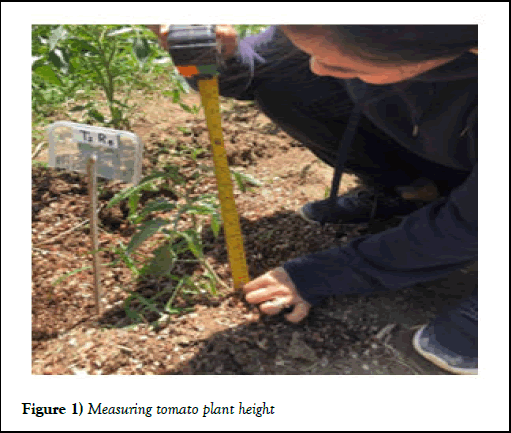
Figure 1) Measuring tomato plant height
• Weed identification: Germinated weeds were monitored and recorded by identifying one week after transplant (Figure 2).
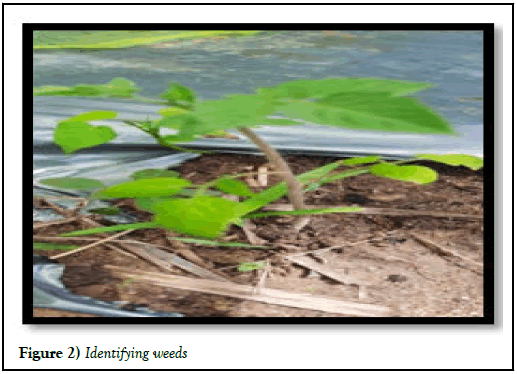
Figure 2) Identifying weeds
• Weed population count: Weed population was counted with an interval of two and four weeks DAT.
• Average weight of harvested tomato per treatment with an interval of 4 days in each harvest (Figure 3).
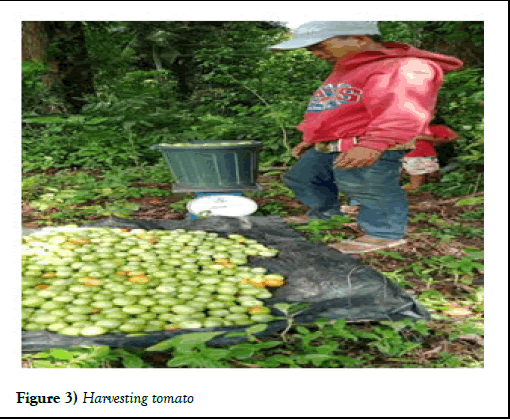
Figure 3) Harvesting tomato
• Documentation: Pictorials was taken which include seeding, land preparation, transplanting, fertilization and maintenance and harvesting.
Statistical process
The data on plant height, weed occurrence, weed population count, and average weight of harvested tomato were analyzed using the Software Statistical Tool for Agricultural Research (STAR computer software). Mean comparison was done using Least Significance Difference (LSD).
The treatments are the different weed control methods as follows: Treatment 1: Plastic mulch, Treatment 2: Organic mulching (Dry wood shaving), Treatment 3: Hand weeding (5 days interval), Treatment 4: Hand weeding (10 days interval), Treatment 5: Pre-emergence herbicide, Treatment 6: Post-emergent herbicide and Treatment 7: Control.
Table 1 shows the plant height in cm of tomato at 20 days after transplanting as affected with different weed management. The data revealed that plastic mulch (T1) is the most effective weed management strategy for promoting tomato plant height at 20 days after transplanting. The plants with T! achieved the highest mean height of 10.1 cm. This was closely followed by the pre-emergence herbicide Alion Bayer (T5), which yielded a mean height of 9.18 cm. In contrast, the control group (T7) exhibited the poorest growth with a mean height of only 5.22 cm. This underscores that the absence of weed management significantly stunts early development of tomatoes. Research of Tomar et al. explained that the effect of different dates of transplanting and different mulching materials significantly influenced the number of branch per plant, fruits per plant, fruit weight and plant height across all growth stages. The data further shows that more frequent intervention is beneficial as weeding at a 5-day interval (T3) produced a higher mean height of 7.9 cm compared to the 6.35 cm observed with a 10-day interval (T4). These findings align with broader studies showing that polyethylene sheet and other mulching methods significantly enhance tomato yield and growth parameters compared to non-mulched or poorly managed soil [6].
| Treatments | Replications | |||||
| 1 | 2 | 3 | 4 | Total | Mean | |
| T1: Plastic mulch | 10.5 | 9.8 | 10.1 | 10 | 40.4 | 10.1 |
| T2: Organic mulching (wood clippings) | 7.3 | 7.1 | 6.9 | 7 | 28.8 | 7.07 |
| T3: Hand weeding (5 days interval) | 7.8 | 7.9 | 8 | 7.9 | 31.6 | 7.9 |
| T4: Hand weeding (10 days interval) | 6.1 | 6 | 6.5 | 6.8 | 25.4 | 6.35 |
| T5: Pre-emergence herbicide (Alion Bayer) | 9 | 9.2 | 9.5 | 9 | 36.7 | 9.18 |
| T6: Post-emergence herbicide (Glyposate) | 8 | 7.1 | 6.9 | 7.2 | 28.2 | 7.05 |
| T7: Control | 5.1 | 5 | 5.3 | 5.5 | 20.9 | 5.22 |
| Grand mean | 7.54 | 7.44 | 8.53 | 7.63 | ||
TABLE 1 Plant height (cm) of tomato at 20 days after transplanting as affected with different weed management
Analysis of variance results on the plant height of tomato at 20 days after transplanting
The Table 2 shows the results of the data analysis using the analysis of variance. The very large F-value (66.3471) indicates that the variation among the treatment means is much larger than the variation within treatments (1.1425). The probability value (p=0) is less than .05 indicates the rejection of the null hypothesis. There is a highly significant difference in tomato plant height among the weed control treatments at 20 days after transplanting.
| ANOVA summary | |||||
| Source | Degrees of Freedom (DF) | Sum of Squares (SS) | Mean Square (MS) | F-Stat | P-Value |
| Between groups | 6 | 66.3471 | 11.0579 | 203.2502 | 0 |
| Within groups | 21 | 1.1425 | 0.0644 | ||
| Total | 27 | 67.4897 | |||
TABLE 2 Analysis of variance results on the plant height of tomato at 20 days after transplanting as affected by the different weed control methods
The significant ANOVA result implies that weed control method strongly influences early tomato growth. Better weed suppression likely reduced competition for light, water, nutrients, and space, allowing plants under plastic much and pre-emergence herbicide to grow taller. The control treatment performed worst because weeds likely competed strongly with tomato plants. Plastic mulch (T!) produced the tallest plants (10.10 cm), followed by preemergence herbicide (T5, 9.18 cm), while the control (T7) had the shortest plants (5.22 cm). This indicates that effective weed management substantially improves tomato growth.
Table 3 shows the ANOVA results of the weed occurrence and weed count after the first application of treatment two weeks after transplanting.
| Data summary | |||||
| Groups | N | Mean | Std. dev. | Std. error | |
| T1: Plastic mulch | 12 | 6.3333 | 6.8931 | 1.9899 | |
| T2: Organic mulching (wood clippings) | 12 | 18.9167 | 8.733 | 2.521 | |
| T3: Hand weeding (5 days interval) | 12 | 11 | 7.7342 | 2.2327 | |
| T4: Hand weeding (10 days interval) | 12 | 37.1667 | 11.7847 | 3.4019 | |
| T5: Pre-emergence herbicide (Alion Bayer) | 12 | 17 | 6.9019 | 1.9924 | |
| T6: Post-emergence herbicide (Glyposate) | 12 | 27.9167 | 5.5671 | 1.6071 | |
| T7: Control | 12 | 74.1667 | 33.9032 | 9.787 | |
| ANOVA summary | |||||
| Source | Degrees of Freedom (DF) | Sum of Squares (SS) | Mean Square (MS) | F-Stat | P-Value |
| Between groups | 6 | 38107.22 | 6351.204 | 28.673 | 0 |
| Within groups | 77 | 17055.86 | 221.5047 | ||
| Total | 83 | 55163.08 | |||
TABLE 3 ANOVA results of the weed occurrence and weed count after the first application of treatment two weeks after transplanting
Table 3 shows that the ANOVA results of 28.673 is statistically significant at the p=.000. This indicates that the null hypothesis is rejected. There is a significant difference among the weed management treatments. The data suggests that effective weed control is important in optimizing tomato plant height in the early stages of growth. Plastic mulch (T!) provided the best results, likely due to its ability completely suppress weed growth, conserve soil moisture, and potentially modify temperature favorably, which are all conducive to rapid seedling development. The effectiveness of the preemergence herbicide (T5) also highlights the importance of preventing weed establishment from the outset. The findings imply that implementing a weed management strategy that provides consistent and early suppression of weeds, such as plastic mulching or the application of pre-emergence herbicides, is most effective for enhancing the initial growth of tomato plants.
Table 4 shows the ANOVA summary which reflects an F-statistic value of 20.7295 and is significant at p=.0000. This indicates that there a statistically significant different in weed counts between at least two of the treatment groups. The between group sum of squares is much larger than the within groups indicating that the treatment choice is a much stronger driver of weed count than random experimental error. The variation in weed suppression is directly attributable to the specific management strategies employed. The plastic mulch is the superior strategy for weed management in tomato cultivation at the four-week mark. While chemical and intensive manual methods (T3 and T5) are valid alternatives, they do not match the near-total suppression by provided by the synthetic barrier. This implies that as weeding frequency decreases or less opaque mulch materials are used, the risk of weed-crop competition significantly increases.
| Data summary | |||||
| Groups | N | Mean | Std. dev. | Std. error | |
| T1: Plastic mulch | 12 | 2.0833 | 7.2169 | 2.0833 | |
| T2: Organic mulching (wood clippings) | 12 | 13.5 | 8.512 | 2.4572 | |
| T3: Hand weeding (5 days interval) | 12 | 4.5833 | 7.7043 | 2.224 | |
| T4: Hand weeding (10 days interval) | 12 | 26.8333 | 9.7125 | 2.8038 | |
| T5: Pre-emergence herbicide (Alion Bayer) | 12 | 4.4167 | 6.5983 | 1.9038 | |
| T6: Post-emergence herbicide (Glyposate) | 12 | 5.9167 | 7.1026 | 2.0503 | |
| T7: Control | 12 | 37.3333 | 19.1185 | 5.519 | |
| ANOVA summary | |||||
| Source | Degrees of Freedom (DF) | Sum of Squares (SS) | Mean Square (MS) | F-Stat | P-Value |
| Between groups | 6 | 13147 | 2191.321 | 20.7295 | 0 |
| Within groups | 77 | 8115.01 | 105.3897 | ||
| Total | 83 | 21262.94 | |||
TABLE 4 Data summary and ANOVA results of the weed identification and weed count after the second application of treatment four weeks after transplanting
Table 5 shows the average weight of tomato fruits from 1st to 3rd harvest. There is no significant difference among the treatment. The F value of 5.6118 is significant at P value of 0.0038. The different treatments resulted to bearing tomatoes of different weight at 1st, 2nd and 3rd harvest. Examining the mean weight, it is observed that among the treatments, the T-1 (Plastic mulch) bared the highest yield as evident by 8.32 kilos and the lowest yield of 4.0 kilos on T-7 (Control).
| Treatment | Number of Harvest | Total | Mean | ||
| 1st | 2nd | 3rd | |||
| T1: Plastic mulch | 6.35 | 10.07 | 8.53 | 24.95 | 8.32 |
| T2: Organic mulching (wood chippings) | 4.1 | 4.4 | 5.3 | 13.8 | 4.6 |
| T3: Hand weeding (5 dyas interval) | 4.75 | 6.71 | 6.33 | 17.79 | 5.93 |
| T4: Hand weeding (10 days interval) | 4.2 | 5.5 | 5 | 14.7 | 4.9 |
| T5: Pre-emergence herbicide (Alion Bayer) | 5.47 | 8.06 | 7.4 | 20.93 | 6.97 |
| T6: Post-emergence herbicide (Glyposate) | 4 | 4.55 | 5.4 | 13.95 | 4.65 |
| T7: Control | 3 | 5.1 | 4.1 | 12.2 | 4 |
TABLE 5 Average weight (kg) of harvested tomato fruits from 1st to 3rd harvest as affected by the different weed management
The above data portrays a highly significant statistical differences among the tested groups. The F-statistic of 5.6118 is significant at the p-value of .0038. The results which indicate that the between groups mean squares sum of squares (42.3598) is exceeds much the within groups (1.2581) suggests that the treatment method is the primary driver of variation in tomato weight (Table 6).
| Source | Degrees of Freedom (DF) | Sum of Squares (SS) | Mean Square (MS) | F-Stat | P-Value |
| Between groups | 6 | 42.3598 | 7.06 | 5.6118 | 0.0038 |
| Within groups | 14 | 17.6129 | 1.2581 | ||
| Total | 20 | 59.9727 |
TABLE 6 Analysis of variance results average weight (kg) of harvested tomato fruits from 1st to 3rd harvest as affected by the different weed management
Based on the result of the study, the used of plastic mulch obtained the most effective control on weed management in Tomato production as it provides the highest plant height, less weed occurrence and bared the highest quantity of fruit among other treatments.
Based on the findings of the study, the following recommendations are drawn that similar study may be conducted using the same weed control management to other vegetable crops, and that similar study will be conducted using the same weed control management and the insect and disease occurrence will be monitored and evaluated.
Received: 06-May-2026, Manuscript No. AGBIR-26-192696; , Pre QC No. AGBIR-26-192696 (PQ); Editor assigned: 08-May-2026, Pre QC No. AGBIR-26-192696 (PQ); Reviewed: 22-May-2026, QC No. AGBIR-26-192696; Revised: 10-Jun-2026, Manuscript No. AGBIR-26-192696 (R); Published: 17-Jun-2026, DOI: 10.37532/0970-1907.26.42(1):1-5