
An International Journal
Agricultural and Biological Research
ISSN - 0970-1907
RNI # 24/103/2012-R1
RNI # 24/103/2012-R1
Research Article - (2026) Volume 42, Issue 2
The heavy reliance on synthetic additives in poultry feed has raised concerns about environmental sustainability, animal health, and the overall resilience of White Leghorn chickens. The study aimed to evaluate the effects of various plant extracts added to drinking water on the growth performance, laying characteristics, and egg quality of White Leghorn chickens. The research was conducted from January to May 2025 in Dinas, Zamboanga del Sur, Philippines, using a Completely Randomized Block Design (CRBD). The treatments consisted of four levels, each replicated three times (n=84 birds; 7 birds/replicate). Treatments consisted of: T1 (vitamin premix control), T2 (150 mL ginger extract/L water), T3 (150 mL Moringa oleifera extract/L water), and T4 (150 mL Annona muricata extract/L water). Growth parameters included weekly weight gain, average daily gain, and Feed Conversion Ratio (FCR). Laying performance was assessed through weekly egg production, Hen-Day Egg Production (HDEP), and FCR for egg production. Egg quality traits measured were egg weight, length, width, shape index, yolk height, yolk diameter, yolk index, and yolk color. Data were analyzed using ANOVA in a completely randomized design with Tukey’s post hoc test. Results showed no significant differences (P>0.05) among treatments in growth performance parameters, indicating that plant extracts supported body weight gain and feed efficiency comparable to the vitamin premix. However, significant and highly significant differences (P<0.05) were observed in laying performance and most egg quality characteristics. Ginger extract supplementation consistently produced higher weekly egg production, improved hen-day egg production, better FCR for egg production, and enhanced egg dimensions and yolk pigmentation compared with other treatments. The economic evaluation further indicated higher returns on investment in the ginger and moringa supplemented groups relative to the control. These findings suggest that phytogenic supplementation, particularly ginger extract, can serve as a natural alternative to synthetic vitamin premixes for improving laying performance and egg quality in White Leghorn chickens without compromising growth performance
Phytogenic additives; Laying hens; Hen-day egg production; Feed efficiency; Egg quality; White Leghorn
The global poultry industry plays a critical role in supplying affordable, high-quality animal protein, with layer production contributing substantially to food security and agricultural economies. Among commercial egg-type breeds, White Leghorn chickens are widely recognized for their superior laying persistency, feed efficiency, and adaptability to intensive production systems [1,2]. Sustaining optimal growth, reproductive performance, and egg quality in White Leghorn layers is therefore essential for economic profitability and production sustainability.
In recent years, increasing restrictions on the use of antibiotic growth promoters have accelerated interest in natural feed additives that can enhance performance while supporting gut health and immune function [3,4]. Phytogenic feed additives, including plant extracts rich in bioactive compounds such as phenolics, flavonoids, alkaloids, and essential oils, have emerged as promising alternatives in poultry nutrition. These compounds are known to exert antimicrobial, antioxidant, anti-inflammatory, and digestive-stimulatory effects, which may collectively improve nutrient utilization and productive performance [5,6].
Sources of plants that have been extensively researched for their phytochemical properties include guava (Psidium guajava; guyabano is Annona muricata when extracted), moringa (Moringa oleifera; locally known as malunggay), and ginger (Zingiber officinale). Bioactive compounds in ginger, such as gingerols and shogaols, have been linked to improved growth and immune response in poultry and possess antioxidant and digestiveenhancing properties [7,8].
Incorporating Moringa oleifera leaves in layer diets has been shown to improve egg production, yolk pigmentation, and shell quality because it is high in vitamins, minerals, carotenoids, and phenolic compounds [9]. According to Botsoglou et al. and Windisch et al. extracts from plants with antimicrobial and antioxidant properties may also help to improve the balance of gut microflora and lower oxidative stress, which are factors that are closely related to laying performance and egg quality parameters like shell thickness, Haugh unit, and yolk color.
Egg quality is a multifactorial trait influenced by genetics, nutrition, environmental conditions, and hen age [10]. Nutritional strategies that enhance nutrient digestibility, calcium metabolism, and antioxidant status may positively affect internal and external egg quality characteristics. Despite growing evidence supporting the efficacy of phytogenic additives in broilers and layers, comparative evaluations of different plant extracts under similar management conditions remain limited, particularly in White Leghorn chickens during the growth-to-lay transition phase.
Therefore, the present study aimed to evaluate the dietary inclusion of selected plant extracts on growth performance, laying traits, and egg quality characteristics in White Leghorn chickens. Specifically, the study compared body weight gain, feed efficiency, hen-day egg production, and key egg quality parameters to assess the potential of phytogenic supplementation as a natural strategy to improve productivity and product quality in commercial layer systems.
Experimental site and duration
The study was conducted from January to August 2025 at a semicommercial poultry facility in Nangka, Dinas, Zamboanga del Sur, Philippines. The experiment evaluated the effects of phytogenic supplementation through drinking water on growth performance, laying traits, and egg quality of White Leghorn chickens under tropical conditions.
Experimental birds and management
A total of 100 White Leghorn pullets (21 days old) were procured from a certified hatchery, including buffer stock to account for potential mortality. Eighty-four clinically healthy birds were randomly selected and assigned to experimental treatments. Birds were individually identified using leg bands. The birds were housed in 12 elevated cages (1.0 m × 1.0 m × 0.8 m), each equipped with feeders and nipple drinkers. Flooring was slightly inclined to facilitate egg collection. Standard management practices, including routine cleaning, disinfection, and biosecurity measures, were implemented throughout the study. Lighting was provided using 25-W bulbs to maintain appropriate photoperiod for layer development. Birds were fed commercial starter and layer diets according to age requirements, and water was provided ad libitum.
Experimental design and treatments
The experiment was arranged in a Completely Randomized Design (CRD) with four treatments and three replicates per treatment (7 birds per replicate).
Treatments were as follows:
T1: Control (commercial vitamin premix in drinking water)
T2: 150 mL ginger (Zingiber officinale) extract per liter of water
T3: 150 mL malunggay (Moringa oleifera) extract per liter of water
T4: 150 mL guyabano (Annona muricata) extract per liter of water
Experimental drinking solutions were prepared daily and supplied throughout the experimental period.
Preparation of plant extracts
Fresh ginger rhizomes, malunggay leaves, and guyabano leaves were washed thoroughly. Plant materials were chopped, blended with distilled water, and filtered using sterile cheesecloth to obtain aqueous extracts. Extracts were stored under refrigeration and prepared fresh daily to ensure phytochemical stability.
Data collection
Growth performance: Body weight was recorded weekly using a digital weighing scale.
Weekly Weight Gain (WWG, g):
WWG = Body weight at current week − Body weight at previous week
Average Daily Gain (ADG, g/day):
ADG=(Final body weight − Initial body weight)/Number of experimental days
Feed Conversion Ratio (FCR, growth phase):
FCR=Total feed intake (g)/Total body weight gain (g)
Laying performance:
• Weekly egg production: Total eggs produced per replicate per week.
• Hen-Day Egg Production (HDEP, %): HDEP=(Number of eggs produced/Number of live hens × Number of days) × 100
• Feed Conversion Ratio (egg production): FCR=Total feed intake (kg)/ Total egg mass (kg)
Egg quality assessment: Egg quality parameters were evaluated weekly from randomly collected samples per replicate.
• Egg weight (g) – digital scale
• Egg length and width (mm) – digital Vernier caliper
• Egg shape index (%) = (Egg width/Egg length) × 100
• Yolk height and diameter (mm) – Vernier caliper
• Yolk index=Yolk height/Yolk diameter
• Yolk color – Roche yolk color fan
Economic analysis
Return on Investment (ROI, %) was calculated as: ROI=(Net income/Total production cost) × 100
Statistical analysis
Data were analyzed using Analysis of Variance (ANOVA) under a completely randomized design using the Statistical Tool for Agricultural Research (STAR). When significant differences were detected (P<0.05), treatment means were separated using Tukey’s Honest Significant Difference (HSD) test. Percentage data were arcsine-transformed prior to analysis when necessary [11,12].
Growth performance
Dietary inclusion of plant extracts did not significantly affect (P>0.05) Weekly Weight Gain (WWG) or Average Daily Gain (ADG) throughout the experimental period. All groups showed progressive increases in body weight, indicating normal physiological growth during the rearing-to-laying transition. The absence of significant growth enhancement suggests that phytogenic supplementation at 150 mL/L water maintained performance comparable to the vitamin premix control. Similar findings were reported by Windisch et al., who noted that phytogenic feed additives often stabilize performance rather than dramatically increasing growth rates. Hashemi and Davoodi likewise observed that herbal additives may improve gut health without necessarily increasing body weight in layers.
White Leghorn chickens are genetically selected for reproductive efficiency rather than rapid muscle accretion, which may explain the limited response in growth traits. Comparable observations were reported in layer-type birds supplemented with herbal extracts, where growth parameters remained unaffected while reproductive traits improved (Table 1).
| Treatments | Initial weight (g) | Week 1 | Week 2 | Week 3 | Week 4 | Week 5 | Week 6 |
| T1 – Vitamin premix | 202.28 | 12.85 | 13.62 | 17.61 | 27.25 | 34.62 | 39.15 |
| T2 – 150 ml ginger extract | 202.08 | 11.9 | 12.81 | 14.43 | 25.71 | 31.43 | 39.86 |
| T3 – 150 ml Malunggay extract | 194.62 | 13.09 | 14.91 | 19.71 | 22.71 | 30.05 | 38.53 |
| T4 – 150 ml Guyabano extract | 201.62 | 13.18 | 14.71 | 21.86 | 27.43 | 39.29 | 38.57 |
| F-test | ns | ns | ns | ns | ns | ns | ns |
| % cv | 5.63 | 10.93 | 12.29 | 16.51 | 14.74 | 12.63 | 8.94 |
| Note: ns: not significant | |||||||
TABLE 1 Weekly weight gain (g) of White Leghorn chicken supplemented with different plant extracts
Feed Conversion Ratio (FCR) during the growth phase was not significantly different among treatments (P>0.05), although numerically lower values were observed in ginger (T2) and guyabano (T4) groups during later weeks. Phytogenic compounds such as phenolics and essential oils have been shown to stimulate digestive secretions and improve intestinal morphology. However, their effects on FCR are often modest in layer strains, particularly when birds are already receiving nutritionally adequate diets. The nonsignificant yet numerically improved FCR observed in T2 and T4 may reflect enhanced nutrient utilization, consistent with reports that phytogenics can improve digestive enzyme activity and microbial balance (Table 2).
| Treatments | Week 1 | Week 2 | Week 3 | Week 4 | Week 5 | Week 6 |
| T1 – Vitamin premix | 3.11 | 2.72 | 2.59 | 2.48 | 2.39 | 2.22 |
| T2 – 150 ml ginger extract | 2.59 | 2.42 | 2.36 | 2.26 | 2.18 | 2.13 |
| T3 – 150 ml Malunggay extract | 2.96 | 2.74 | 2.55 | 2.44 | 2.28 | 2.19 |
| T4 – 150 ml Guyabano extract | 2.58 | 2.47 | 2.36 | 2.27 | 2.19 | 2.09 |
| F-test | ns | ns | ns | ns | ns | ns |
| % cv | 15.88 | 14.25 | 12.66 | 11.32 | 7.91 | 6.64 |
| Note: ns: not significant | ||||||
TABLE 2 Feed Conversion Ratio (FCR) of White Leghorn chicken eggs supplemented with different plant extracts
Laying performance
Significant (P<0.05) and highly significant (P<0.01) differences were observed in weekly egg production, particularly during the early laying period. Ginger supplementation (T2) resulted in consistently higher egg output during weeks 1–3.
This finding agrees with Zhang et al., who reported improved laying rate and antioxidant status in hens supplemented with ginger root. Similarly, Botsoglou et al., demonstrated that dietary herbal extracts enhanced laying performance and oxidative stability of eggs. The enhanced early production may be linked to improved antioxidant capacity, which supports ovarian follicular development and reduces oxidative stress during onset of lay. By the later weeks, egg production among treatments converged, suggesting that phytogenic extracts sustained production levels comparable to synthetic supplementation during peak lay (Table 3).
| Treatments | Week 1 | Week 2 | Week 3 | Week 4 | Week 5 | Week 6 |
| T1 – Vitamin premix | 24.33b | 30.00b | 36.00b | 41.00b | 44.67b | 47.67a |
| T2 – 150 ml ginger extract | 27.67a | 32.00a | 38.67a | 44.00a | 44.67a | 45.67a |
| T3 – 150 ml Malunggay extract | 23.67b | 28.33b | 34.33c | 41.33b | 44.00b | 45.67b |
| T4 – 150 ml Guyabano extract | 23.67b | 30.00b | 33.33c | 41.43b | 42.67c | 46.00b |
| F-test | ** | ** | ** | * | * | ** |
| % cv | 3.68 | 3.03 | 2.81 | 2.54 | 1.59 | 1.38 |
| Note: Means with the same letter are not significantly different. ns=not significant; *= significant; **= highly significant | ||||||
TABLE 3 Weekly egg production (no. of eggs) of White Leghorn chicken supplemented with different plant extract
Hen-day egg production showed significant improvements in the ginger group from week 2 onward. Birds receiving ginger extract achieved the highest HDEP values during most weeks and reached comparable peak production with the control group by week 6.
Improved HDEP in phytogenic-supplemented hens has been associated with enhanced metabolic efficiency and immune modulation. The bioactive compounds in ginger, including gingerols and shogaols, possess antioxidant and anti-inflammatory properties that may improve reproductive performance.
The consistent upward trend in HDEP across treatments also confirms that plant extracts did not negatively affect laying persistency, an important commercial trait in White Leghorn hens (Table 4).
| Treatments | Week 1 | Week 2 | Week 3 | Week 4 | Week 5 | Week 6 |
| T1 – Vitamin premix | 49.66 | 61.22b | 73.47b | 83.67b | 91.16b | 97.28a |
| T2 – 150 ml ginger extract | 54.42 | 65.31a | 78.92a | 89.80a | 95.24b | 97.96a |
| T3 – 150 ml Malunggay extract | 48.3 | 57.82b | 70.07bc | 84.35b | 89.80b | 93.20b |
| T4 – 150 ml Guyabano extract | 48.3 | 61.22b | 68.03c | 84.35b | 87.08c | 93.88b |
| F-test | ns | ** | ** | * | ** | ** |
| % cv | 8.87 | 3.04 | 2.81 | 2.84 | 1.59 | 1.38 |
| Note: Means with the same letter are not significantly different. ns=not significant; *= significant; **=highly significant | ||||||
TABLE 4 Weekly hen day production (%) of White Leghorn chicken supplemented with different plant extracts
Although most weekly comparisons were not statistically significant, numerically improved egg production FCR was observed in malunggay (T3) and guyabano (T4) groups during later weeks. Lower FCR values indicate more efficient conversion of feed into egg mass. Phytogenic additives are known to enhance nutrient digestibility and lipid metabolism, which may contribute to improved egg mass efficiency. Abou-Elezz et al., reported that inclusion of Moringa oleifera improved feed efficiency in laying hens, supporting the trend observed in the present study (Table 5).
| Treatments | Week 1 | Week 2 | Week 3 | Week 4 | Week 5 | Week 6 |
| T1 – Vitamin premix | 3.17 | 2.89 | 2.82 | 2.73b | 2.67 | 2.61 |
| T2 – 150 ml ginger extract | 3.06 | 2.97 | 2.88 | 2.85a | 2.73 | 2.64 |
| T3 – 150 ml Malunggay extract | 2.86 | 2.78 | 2.73 | 2.67b | 2.6 | 2.53 |
| T4 – 150 ml Guyabano extract | 2.9 | 2.77 | 2.71 | 2.65b | 2.58 | 2.49 |
| F-test | ns | ns | ns | * | ns | ns |
| % cv | 5.43 | 2.97 | 2.59 | 2.25 | 3.05 | 3.21 |
| Note: Means with the same letter are not significantly different. ns=not significant; *= significant | ||||||
TABLE 5 Feed Conversion Ratio (FCR) on egg production of white leghorn chicken supplemented with different plant extract
Egg quality
Egg weight was not significantly affected (P>0.05) by plant extract supplementation. All treatments produced eggs within the typical commercial range (50–53 g), indicating that phytogenic inclusion did not compromise egg size.
Roberts emphasized that egg weight is primarily influenced by genetic and nutritional energy factors rather than phytogenic additives, which supports the stability observed in this study (Table 6).
| Treatments | Week 1 | Week 2 | Week 3 | Week 4 | Week 5 | Week 6 |
| T1 – Vitamin premix | 51 | 51 | 50.67 | 52 | 52 | 51.33 |
| T2 – 150 ml ginger extract | 51 | 51.67 | 50.67 | 52 | 51.67 | 52.33 |
| T3 – 150 ml Malunggay extract | 51 | 51.67 | 51.67 | 51.67 | 52 | 52.67 |
| T4 – 150 ml Guyabano extract | 51.33 | 51.33 | 51.67 | 50.33 | 51.6 | 52.67 |
| F-test | ns | ns | ns | ns | ns | ns |
| % cv | 2.04 | 2.17 | 2.26 | 2.1 | 1.58 | 1.46 |
| Note: Means with the same letter are not significantly different. ns=not significant | ||||||
TABLE 6 Weekly egg weight (g) of white leghorn chicken eggs supplemented with different plant extracts
Egg length and width were significantly influenced by treatment, with ginger supplementation producing larger egg dimensions. Egg shape index values remained within commercially acceptable ranges (72–80%). Herbal supplementation has been reported to influence shell formation and albumen deposition through improved mineral metabolism and antioxidant status. The enhanced egg dimensions observed in the ginger group may reflect improved nutrient partitioning during shell formation (Table 7).
| Treatments | Length | Width |
| T1 – Vitamin premix | 54.50b | 43.50b |
| T2 – 150 ml ginger extract | 56.92a | 44.24a |
| T3 – 150 ml Malunggay extract | 53.72b | 42.80c |
| T4 – 150 ml Guyabano extract | 53.56 | 43.02bc |
| F-test | ** | ** |
| %cv | 1.11 | 0.764 |
| Note: Means with the same letter are not significantly different. Ns: not significant; **=highly significant | ||
TABLE 7 Egg length and width (mm) of white leghorn chicken eggs supplemented with different plant extracts
Yolk height and diameter were significantly higher (P<0.01) in the gingersupplemented group. Increased yolk height is an indicator of superior internal egg quality and freshness. Antioxidant-rich phytogenic additives have been shown to enhance yolk structural integrity by reducing lipid peroxidation. Improved yolk dimensions in T2 may therefore be associated with enhanced oxidative stability (Table 8).
| Treatment | Height | Diameter |
| T1 – Vitamin premix | 13.43b | 33.74b |
| T2 – 150 ml ginger extract | 15.48a | 37.10a |
| T3 – 150 ml Malunggay extract | 13.61b | 34.14b |
| T4 – 150 ml Guyabano extract | 13.35b | 35.01b |
| F-test | ** | ** |
| % cv | 4.1 | 3.02 |
| Note: Means with the same letter are not significantly different. **=highly significant | ||
TABLE 8 Egg yolk height and diameter (mm) of White Leghorn chicken eggs supplemented with different plant extracts
Yolk index did not differ significantly among treatments, although ginger supplementation produced numerically higher values. The absence of significant variation suggests that all treatments maintained acceptable internal egg quality parameters (Table 9).
| Treatment | Yolk index |
| T1 – Vitamin premix | 40 |
| T2 – 150 ml ginger extract | 41.74 |
| T3 – 150 ml Malunggay extract | 39.89 |
| T4 – 150 ml Guyabano extract | 38.12 |
| F-test | ns |
| % cv | 4.37 |
| Note: Means with the same letter are not significantly different. ns=not significant | |
TABLE 9 Egg yolk index (%) of white leghorn chicken eggs supplemented with different plant extracts
Yolk color was significantly enhanced in the ginger group (P<0.01). Yolk pigmentation is strongly influenced by dietary carotenoids and antioxidant compounds. Natural plant extracts rich in bioactive pigments can enhance yolk coloration without synthetic pigments, improving consumer acceptance while supporting clean-label egg production systems (Table 10).
| Treatment | Yolk color index |
| T1 – Vitamin premix | 10.67b |
| T2 – 150 ml ginger extract | 12.33a |
| T3 – 150 ml Malunggay extract | 9.33a |
| T4 – 150 ml Guyabano extract | 9.67a |
| F-test | ** |
| % cv | 7.27 |
| Note: Means with the same letter are not significantly different. **=highly significant | |
TABLE 10 Egg yolk color rates of white leghorn chicken eggs supplemented with different plant extracts
Economic evaluation (Return on investment)
All treatments incurred identical production costs; however, higher egg output in the ginger group resulted in superior net income and ROI (45.19%). Improved profitability linked to phytogenic supplementation has been attributed to enhanced feed efficiency and reproductive performance. The present findings demonstrate that ginger extract can improve economic returns without increasing production inputs (Figure 1).
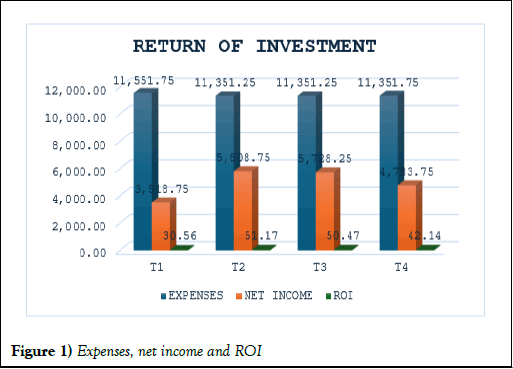
Figure 1) Expenses, net income and ROI
Dietary inclusion of plant extracts did not significantly influence growth performance but positively affected laying performance and selected egg quality parameters. Ginger extract supplementation produced the most consistent improvements in egg production, yolk quality, and economic return.
Dietary inclusion of plant extracts through drinking water did not significantly influence growth performance parameters, including weekly weight gain, average daily gain, and growth-phase feed conversion ratio, in White Leghorn chickens. These findings indicate that phytogenic supplementation at 150 mL/L water maintained growth comparable to a conventional vitamin premix without adverse effects. In contrast, laying performance was significantly affected by treatment. Ginger (Zingiber officinale) extract supplementation consistently improved weekly egg production and hen-day egg production, particularly during the early laying period. While production levels among treatments converged during peak lay, ginger supplementation demonstrated a clear advantage in accelerating and stabilizing early egg output. Feed conversion efficiency for egg production was numerically improved in phytogenic-treated groups, indicating effective nutrient utilization without increased feed input.
Egg quality responses varied by parameter. Egg weight remained unaffected by treatment, confirming that plant extract inclusion did not compromise commercial egg size. However, ginger supplementation significantly enhanced egg dimensions, yolk height, yolk diameter, and yolk pigmentation, reflecting improvements in internal egg quality and consumer-preferred traits. Malunggay (Moringa oleifera) and guyabano (Annona muricata) extracts maintained acceptable performance and quality metrics but did not consistently match the improvements observed with ginger extract. Economic analysis further demonstrated that ginger supplementation yielded the highest return on investment due to improved laying performance without additional production costs.
Phytogenic supplementation, particularly ginger extract administered via drinking water, can serve as a viable natural alternative to synthetic vitamin premixes in White Leghorn layer production systems under tropical conditions. Its inclusion enhances reproductive performance and selected egg quality traits while maintaining growth efficiency and improving economic returns.
[Crossref] [Google Scholar] [PubMed]
[Crossref] [Google Scholar] [PubMed]
[Crossref] [Google Scholar] [PubMed]
[Crossref] [Google Scholar] [PubMed]
[Crossref] [Google Scholar] [PubMed]
[Crossref] [Google Scholar] [PubMed]